


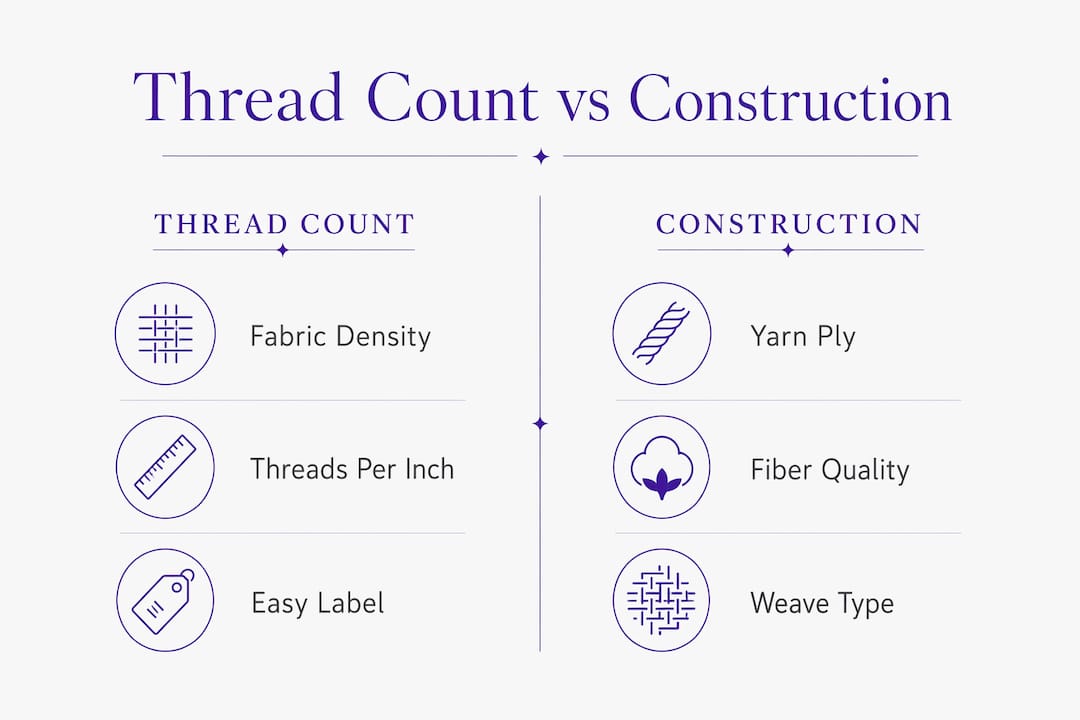
Thread count is the total number of warp threads (running lengthwise) plus weft threads (running widthwise) woven into one square inch of fabric. For shirts, it signals how densely the cloth is woven, but it tells you nothing about fiber quality, ply, weave structure, or how the shirt will actually feel after twenty washes. That distinction matters more than most labels let on.
Three things to know before you buy:
- A shirt in the 100–200 TC range is not automatically inferior; yarn fineness and fiber origin often matter more than TC alone.
- Watch for ply inflation: a “600 TC” shirt made by counting two-ply yarns separately is effectively a 300 TC fabric in single-yarn terms.
- When a label lists fiber grade (long-staple cotton, Egyptian, Supima) alongside yarn count, prioritize that information over the headline TC number.
Table of Contents
- What does thread count mean for shirts, exactly?
- Why ply and yarn count usually tell you more
- How thread count affects softness, durability, and breathability
- Common misconceptions and marketing tricks around thread count
- How to choose a shirt using thread count as one input
- How to care for shirts based on construction
- Moreciandco’s perspective on the sweet spot for dress shirts
- Key Takeaways
- Why construction beats thread count every time
- Shirts with transparent construction specs at Moreciandco
- Sources and further reading
What does thread count mean for shirts, exactly?
Thread count equals the sum of ends per inch (EPI, the warp) and picks per inch (PPI, the weft) measured across one square inch of woven cloth. A fabric with 100 EPI and 90 PPI carries a thread count of 190. Simple arithmetic, but the implications branch quickly.
Two fabrics can share the same TC and feel completely different because the count says nothing about:
- Yarn fineness: thinner yarns pack more threads without adding weight or stiffness.
- Ply: whether each “thread” is a single strand or two twisted together.
- Weave: poplin, twill, and oxford all behave differently at the same TC.
- Fiber quality: short-staple commodity cotton versus long-staple Egyptian Giza are worlds apart in hand and durability.
Retail conventions make this murkier. Some mills count each ply of a two-ply yarn as a separate thread, which can double the marketed number without changing how the fabric performs. The number on the label is a starting point, not a verdict.
Why ply and yarn count usually tell you more
Ply describes how many individual strands are twisted together to form a single thread. A two-ply yarn (written as 100/2) twists two finer strands together, which boosts tensile strength and pilling resistance compared to a single-ply yarn of the same numeric count. The tradeoff is that some brands count each ply separately, so a genuine 300 TC two-ply fabric gets marketed as 600 TC.
Yarn count (expressed in the English system as “Ne” or in shorthand like “80s,” “100s,” “120s”) measures yarn fineness. Higher numbers mean finer yarn. An 80s single-ply shirt is a solid everyday workhorse; a 120s two-ply dress shirt in long-staple cotton is noticeably smoother and more refined. The yarn count system is the same logic behind suit fabric grades like Super 100s.
Consider two shirts at 200 TC:
- Shirt A: 200 TC, 60s single-ply, short-staple cotton, plain weave. Serviceable, slightly rough after washing.
- Shirt B: 200 TC, 100s two-ply, long-staple Egyptian cotton, poplin weave. Noticeably smoother, more durable, better drape.
Same headline number, very different garments. Weave compounds this further. Different shirt weaves like poplin, twill, and oxford alter drape, opacity, and wrinkle behavior at the same TC. A poplin at 180 TC will look crisper and feel lighter than an oxford at 180 TC, which carries more texture and weight by design.
Pro Tip: When comparing two shirts at similar TC, ask for the yarn count (Ne) and ply. A 100s two-ply construction at 180 TC will outlast and outperform a 60s single-ply at 250 TC in most dress-shirt scenarios.
How thread count affects softness, durability, and breathability
The practical effects of TC on a shirt break down across several dimensions, and typical retail shirting exhibits a range of lower, medium, and higher thread count categories without specifying exact numbers. |—|—|—|—| | Softness / hand | Coarser feel; improves with fiber quality | Smooth with good yarn; noticeable upgrade | Very smooth if yarn is fine; diminishing returns above 400 | | Durability | Durable if yarn is thick; prone to pilling with poor fiber | Good balance; two-ply construction helps significantly | Can weaken if threads are too fine and packed too tightly | | Breathability | Open weave; excellent airflow | Good; depends on weave type | Can restrict airflow at very high counts | | Appearance / drape | Casual, textured look | Clean, structured drape | Lustrous, refined; weave determines sheen | | Care requirements | Forgiving; machine wash warm | Moderate care; cold wash preferred | Gentle cycle, low heat; finer yarns need more attention |
Retail shirting commonly falls into these practical bands: 100–150 for basic casual shirts, 150–200 for standard everyday wear, 200–400 for good-to-premium dress shirts, and 400–600+ for luxury territory where ply inflation becomes a real concern. Polos and tees typically occupy the lower-to-mid ranges, while dress shirts favor the mid-to-high end.
A shirt with moderate true thread count made from fine single yarns can feel smoother and breathe better than a higher marketed thread count shirt constructed by counting multi-ply yarns separately. Chasing the highest number is the wrong game.
Pro Tip: The sweet spot for most dress shirts involves moderate thread count with two-ply construction in long-staple cotton. That combination balances softness, durability, and reasonable care requirements without the fragility that comes with ultra-fine, ultra-high-count fabrics.
Common misconceptions and marketing tricks around thread count
The bedding industry weaponized thread count as a marketing shorthand in the 1990s, and shirting followed. Several myths stuck.
The biggest myths:
- Higher TC always means better quality. Not true. Fiber grade, yarn count, ply, weave, and finishing all outweigh TC as predictors of long-term performance.
- TC alone measures fabric quality. TC measures density only. It says nothing about fiber quality, weave type, ply, finish, or durability.
- A 1,000+ TC shirt is inherently superior. Counts that high almost always involve multi-ply inflation or extremely fine yarns that sacrifice durability for a silky initial feel.
Multi-ply inflation explained: A brand weaves a 300 TC fabric using two-ply yarns, then counts each ply as a separate thread. The label reads 600 TC. That 600 TC is effectively a 300 TC fabric in single-yarn terms and rarely delivers extra functional benefit. Buyers should scrutinize any count above 600 without a corresponding yarn-count and ply disclosure.
Red flags on a shirt label:
- TC above 600 with no yarn count or ply information listed.
- No fiber origin or grade (just “100% cotton” with no further detail).
- No care instructions or vague ones (“dry clean recommended” on a basic cotton shirt).
- Price that seems low for the claimed TC and fiber grade.
- No mention of weave type.
How to choose a shirt using thread count as one input
Start with intended use, then work through construction specs. TC is the last box to check, not the first.
Step-by-step checklist:
- Define the use case. Everyday casual, travel, formal office, or workwear each call for different fabric priorities. A travel shirt needs wrinkle resistance; a formal dress shirt needs drape and a refined surface.
- Check fiber grade first. Look for long-staple cotton (Egyptian, Supima, Giza) for premium shirts. Long-staple fiber produces smoother, more durable cloth than short-staple equivalents.
- Find the yarn count. 80s is solid for everyday wear; 100s–120s signals premium dress shirting. Anything above 120s is specialty territory.
- Confirm single vs. two-ply. Two-ply construction adds durability and pilling resistance. For a shirt you plan to wear regularly, two-ply is worth the slight price premium.
- Identify the weave. Poplin for a crisp, lightweight dress shirt; twill for a softer drape with subtle texture; oxford for a casual, textured look. Check the dress shirt fabric guide for a full breakdown.
- Note GSM or weight if listed. Lighter GSM (around 100–120 g/m²) suits warm climates and travel; heavier (130–160 g/m²) works for structured office wear.
- Then check TC. For casual shirts, a lower thread count range is typical, while dress shirts tend to occupy a moderate thread count range; above that, buyers should scrutinize ply and yarn count before paying more.
Questions to ask sellers or customer service:
- What is the exact thread count, and is it measured in single-ply or multi-ply terms?
- What is the yarn count (Ne) and ply construction?
- What is the fiber origin and grade?
- What finishing treatments have been applied (mercerization, anti-wrinkle)?
- Can you provide a swatch or sample before ordering?
Trust signals worth preferring: full construction specs on the product page, mill or origin disclosure, clear care instructions, and an honest price-to-spec explanation. Retailers that disclose full specs are simply more trustworthy than those hiding behind a single TC number.
How to care for shirts based on construction
Finer yarns and higher thread counts need gentler handling. The construction of the shirt determines the right care routine, not just the fiber content label.
General rules by TC range:
- Low TC (100–150): Machine wash warm, normal cycle, tumble dry low. These fabrics are forgiving and built for regular use.
- Medium TC (150–280): Cold wash, gentle cycle, low spin speed. Tumble dry on low or line dry to preserve hand and reduce shrinkage.
- High TC (above 280): Cold wash, delicate cycle, minimal agitation. Line dry or lay flat. High-count fabrics with fine yarns can distort under heat or mechanical stress.
Washing: Long-staple cotton shirts benefit from a mild detergent without optical brighteners, which can degrade fiber over time. Avoid hot water; it accelerates shrinkage and weakens fine yarns faster than cold cycles do.
Ironing: For poplin and fine twill shirts, a medium-hot iron (cotton setting) works well while the fabric is slightly damp. Oxford weaves tolerate a slightly higher temperature. For two-ply constructions in fine yarn counts, iron dress shirts with steam rather than dry heat to avoid flattening the yarn’s natural loft.
Storage: Hang dress shirts on wide, shaped hangers to preserve shoulder structure. Fold casual shirts rather than cramming them; tight folding along the same crease repeatedly will weaken fine yarns at the fold line over time.
Pro Tip: Turn shirts inside out before washing. It protects the outer surface from abrasion against other garments and keeps the visible face of the fabric looking newer for longer, especially on finer weaves.
Moreciandco’s perspective on the sweet spot for dress shirts
Moreciandco’s position is straightforward: the headline TC number is the least useful spec on a shirt label. What actually predicts whether a shirt holds up, stays comfortable, and looks sharp after repeated wear is the combination of fiber origin, yarn count, ply, and weave.
For dress shirts, the practical sweet spot sits at 180–280 TC with a two-ply construction in long-staple cotton. That range gives you a fabric dense enough for a refined surface and smooth drape, without the fragility that comes from packing ultra-fine yarns too tightly. Egyptian and Supima long-staple cotton at this construction level will outlast and outperform a higher-TC shirt made from short-staple fiber, often by years.
Beyond fabric, stitching and construction signals matter just as much. Seam allowance, stitch density, and collar construction all affect how a shirt wears and holds its shape. A beautifully spec’d fabric sewn poorly is still a poorly made shirt. For shoppers who want to evaluate quality fabrics more broadly, the luxury fabric guide at Fora Leonara covers construction signals that complement what TC alone cannot tell you.
Two-ply construction boosts durability and pilling resistance versus single-ply equivalents, which is why mills choose ply to match end-use expectations rather than simply maximizing thread count.
Pro Tip: When evaluating a premium dress shirt, ask for the yarn count in Ne (English count). A 100s two-ply in Egyptian cotton at 220 TC is a better long-term investment than a 400 TC shirt with no ply or fiber disclosure.
Key Takeaways
Thread count measures fabric density, not quality. For shirts, yarn count, ply, fiber origin, and weave are stronger predictors of long-term performance than the headline TC number.
| Point | Details |
|---|---|
| TC measures density only | Thread count = EPI + PPI; it does not indicate fiber quality, ply, weave, or durability. |
| Practical dress shirt range | 180–280 TC with two-ply construction covers most premium dress shirt needs without fragility. |
| Ply inflation is real | A 600 TC label using two-ply counting is effectively 300 TC in single-yarn terms; scrutinize counts above 600. |
| Yarn count and fiber matter more | Long-staple cotton (Egyptian, Supima) at 100s–120s yarn count outperforms higher-TC short-staple fabric. |
| Moreciandco’s approach | Moreciandco lists full construction specs, including fiber origin and care guidance, so buyers can evaluate shirts on real criteria. |
Why construction beats thread count every time
Thread count became a shorthand because it is easy to print on a label and easy for consumers to compare. That convenience turned it into a marketing lever, and the number drifted away from what it was supposed to signal. The shirts that hold up, feel better with age, and actually justify their price are almost never the ones with the highest TC. They are the ones built from the right fiber, spun to the right yarn count, woven in the right structure, and finished with care.
The practical lesson: use TC as a rough filter to eliminate obvious outliers (very low counts for a dress shirt, suspiciously high counts without supporting specs), then shift your attention to fiber origin, yarn count, ply, and weave. Those four variables will tell you far more about what you are actually buying. For shoppers who want a deeper look at formal shirting choices and fabric recommendations, the formal shirting guide at Fora Leonara is worth reading alongside the specs.
Shirts with transparent construction specs at Moreciandco
Most shirt labels give you a TC number and stop there. Moreciandco does it differently: every shirt in the collection comes with full construction specs, including fiber origin, yarn count, ply, weave type, and care instructions, so you know exactly what you are paying for before you buy.
The Complesso Collection is built on this principle. Fabrics are selected for the combination of fiber grade, yarn construction, and weave that produces a shirt worth wearing for years, not just a number worth printing on a tag. If you want to see what transparent spec pages look like in practice, the Complesso Tee is a good starting point: bamboo-cotton construction, made in Portugal, with full material and care details listed. Browse the full collection at Moreciandco and reach out directly if you want fabric specs or a swatch before committing.
Sources and further reading
- Apex Fashion Lab: Thread Count Guide — Covers the ASTM measurement method, TC quality scale, and ply inflation mechanics.
- Apparel.wiki: Thread Count vs. Yarn Count — Seven practical checks for evaluating fabric specs; strong on why yarn count predicts performance better than TC.
- Parisian Gentleman: Understanding Yarn Count of Shirts and Suits — Explains the Ne yarn count system and how ply affects durability and hand.
- Montauk Style: The Thread Count Fallacy — Detailed look at multi-ply inflation and how marketing exploits TC confusion.
- NatuClothes: Shirt Fabric Types — Data guide to weaves and fibers; useful for understanding how poplin, twill, and oxford interact with TC.
- EthixMerch: Thread Count for Polo Shirts — Practical apparel TC ranges for polos and casual shirts.
- Moreciandco: Why Egyptian Cotton Shirts Are Better — Explains long-staple fiber advantage and how it interacts with yarn count and finishing.
- Moreciandco: Dress Shirt Fabric Types Explained — Full guide to weaves, fibers, and GSM for dress shirt shoppers.