


Dress shirt fabric types are defined by two factors: weave structure and fiber composition. Both determine how a shirt looks, feels, and holds up over time. Get the weave wrong and you show up to a board meeting in a shirt better suited for brunch. Get the fiber wrong and you spend the afternoon uncomfortable. This guide breaks down every major fabric type, from Oxford cloth to Egyptian cotton, so you can buy with confidence instead of guessing at the rack.
What are the main dress shirt fabric types explained by weave?
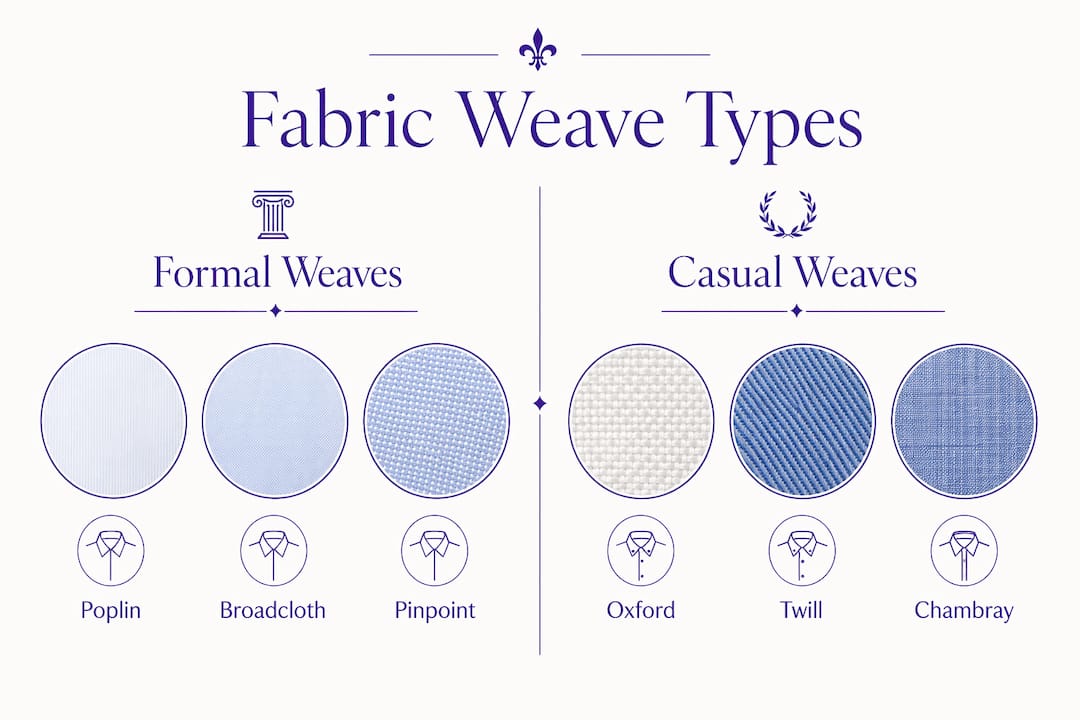
Weave is the first thing that separates one dress shirt fabric from another. It controls texture, weight, breathability, and how formal the shirt reads at a glance.
Poplin is the standard for formal dress shirts. It weighs 3.5–5 oz, with a smooth, crisp surface that photographs well and pairs cleanly with a suit. That low weight makes it the go-to for warm offices and summer weddings. The trade-off is wrinkle sensitivity. Poplin creases easily, so you need to iron it before every wear.
Oxford cloth sits on the opposite end of the texture scale. It weighs 5–7 oz, with a basket weave that gives it a visible, slightly rough texture. That weight makes it durable and casual-leaning. Oxford is the fabric behind the classic American button-down, the kind you wear untucked on a Friday or tucked in for business casual. Pinpoint Oxford is a finer version of the same weave, sitting closer to formal territory.
Twill uses a diagonal weave pattern that produces a soft drape and natural wrinkle resistance. It weighs 5–7 oz and sits between Oxford and poplin in formality. Herringbone is a variation of twill with a zigzag pattern that adds visual interest without sacrificing that wrinkle resistance. Both are strong choices for men who wear dress shirts daily and need fabrics that recover well between wears.
Broadcloth is often confused with poplin because both use a plain weave. The difference is yarn packing. Broadcloth has a denser weave than poplin, which gives it a subtle sheen and a more formal appearance. It suits professional settings where you want the shirt to look polished without any texture.
Chambray looks like denim but weighs far less. It uses a plain weave with colored warp threads and white weft threads, creating a soft, casual appearance. Chambray is not a formal fabric. It belongs in business casual or weekend wardrobes.
| Fabric | Weight | Formality | Wrinkle Resistance |
|---|---|---|---|
| Poplin | 3.5–5 oz | High | Low |
| Oxford | 5–7 oz | Casual to business casual | Medium |
| Twill | 5–7 oz | Medium to high | High |
| Broadcloth | 3.5–5 oz | High | Low |
| Chambray | 3–4 oz | Casual | Medium |
Pro Tip: If you travel frequently, twill and pinpoint Oxford are your best options. Both fabrics resist wrinkles when packed in a suitcase, which means you can pull a shirt out of your bag and wear it without an iron.
How does fiber composition affect comfort and performance?
Weave tells you how a fabric is constructed. Fiber tells you how it behaves against your skin. The two work together, but fiber is what determines breathability, moisture management, and long-term comfort.
Cotton is the dominant fiber in quality dress shirts. Its moisture regain sits at 7–8%, meaning it absorbs sweat and releases it through evaporation rather than trapping it on your skin. Linen absorbs even more at roughly 12% moisture regain, making it the most breathable natural fiber available. Polyester, by contrast, has a moisture regain of only 0.4%. That number explains why polyester shirts feel clammy in warm conditions.
Not all cotton is equal. Here is how the main types compare:
- Upland cotton is the most common variety. It is affordable and widely available but has a shorter fiber length, which produces a coarser feel over time.
- Pima cotton (also sold as Supima when grown in the United States) has longer fibers, which means a softer hand feel and better durability.
- Egyptian cotton has the longest fibers of the three. It produces the smoothest, most luxurious fabric and is the standard in high-end dress shirts.
Yarn construction matters as much as fiber type. 2-ply yarns, made by twisting two single threads together before weaving, produce a stronger, smoother fabric than 1-ply yarns used in cheaper shirts. A shirt labeled 100/2 Ne uses 2-ply yarn at a fine count. That construction resists pilling, holds its shape after washing, and drapes better over time.
Polyester-cotton blends are sold as a practical choice because they resist wrinkles. The problem is that polyester’s low moisture absorption causes sweat to accumulate on the skin surface, which feeds odor-causing bacteria. For a shirt you wear all day in a professional setting, that trade-off is rarely worth it.
How do you choose dress shirt fabric by lifestyle and season?
The most common mistake buyers make is choosing fabric based only on appearance, ignoring how the shirt will actually be used. A beautiful poplin shirt worn in a humid climate without air conditioning is a miserable experience. Matching fabric to your actual routine is the practical skill that separates a good wardrobe from an expensive one.
Use this framework to match fabric to context:
-
Formal office or client-facing roles: Choose poplin or broadcloth. Both deliver the crisp, smooth appearance that reads as polished and professional. Finer weaves like broadcloth suit boardrooms and formal presentations. Pair them with a suit and you have a combination that holds up visually all day.
-
Business casual environments: Oxford cloth and chambray work well here. Oxford gives you texture and durability without looking too casual. Chambray reads as relaxed but still put-together when worn with chinos or tailored trousers. Check the business casual wardrobe essentials guide for more context on building this category.
-
Warm climates or summer wear: Poplin and linen are the right calls. Linen wrinkles easily but breathes better than any other fabric. If you can accept the creases, linen is unbeatable in heat. Poplin is the wrinkle-free alternative for the same conditions.
-
Cooler seasons: Twill and flannel add warmth without bulk. Twill’s diagonal weave traps slightly more air than poplin, making it noticeably warmer. Flannel is the heaviest option and works best in cold-weather business casual settings.
-
Frequent travelers: Twill and pinpoint Oxford are the practical choices. Both recover from packing better than poplin or broadcloth. If you are pulling shirts from a carry-on bag three days a week, wrinkle resistance is not a luxury. It is a requirement. Knowing how to iron dress shirts properly also extends the life of any fabric you choose.
What are the biggest misconceptions about dress shirt fabrics?
The fabric name on a label tells you less than most buyers think. A shirt called “Egyptian cotton” can range from mediocre to exceptional depending on yarn count, ply, and weave. The name alone is not a quality guarantee.
Here are the most common misconceptions worth correcting:
-
“Thread count equals quality.” Thread count matters in bedsheets. In dress shirts, yarn count (Ne) and ply are the relevant specs. Formal shirts typically use yarn counts of 100/2 to 140/2 Ne and weigh 110–140 g/m². A shirt with a high thread count but 1-ply construction will still pill and lose shape faster than a lower-count 2-ply shirt.
-
“Polyester blends are practical for professional wear.” Wrinkle resistance is real, but the comfort cost is significant. Polyester blends trap sweat and odor in ways that pure cotton does not. For a shirt worn in a professional setting for eight or more hours, pure cotton or a high-quality linen blend performs better.
-
“Heavier fabric means better quality.” Weight (GSM) is a spec, not a ranking. A 220 g/m² fabric is not better than a 110 g/m² fabric. It is heavier, which suits cooler climates and casual wear. A lightweight poplin at 110 g/m² is exactly right for formal summer wear. Match weight to use case, not to a quality assumption.
-
“Oxford cloth is too casual for the office.” Pinpoint Oxford sits close enough to formal that it works in most business environments. The key is fit and styling. A well-fitted pinpoint Oxford shirt with a tie reads as professional in most offices outside of finance and law.
Pro Tip: Before buying, check the fabric spec label for GSM, yarn count, and ply. If those details are not listed, that absence tells you something about the manufacturer’s confidence in the product.
Key Takeaways
Dress shirt fabric performance is determined by weave structure, fiber type, yarn count, and ply construction together, not by fabric name alone.
| Point | Details |
|---|---|
| Weave sets formality | Poplin and broadcloth read formal; Oxford and chambray suit casual to business casual. |
| Fiber drives comfort | Cotton absorbs 7–8% moisture; polyester absorbs only 0.4%, causing sweat and odor issues. |
| 2-ply construction lasts longer | 2-ply yarns resist pilling and hold shape better than 1-ply used in cheaper shirts. |
| Match fabric to lifestyle | Travelers need twill or pinpoint Oxford; warm climates call for poplin or linen. |
| Labels can mislead | Check GSM, yarn count, and ply rather than relying on fiber name alone. |
Why fabric knowledge changed how I shop for shirts
I spent years buying dress shirts based on how they looked on the hanger. A smooth finish, a good color, a price that felt reasonable. That approach produced a closet full of shirts that looked fine at 9 a.m. and felt terrible by noon.
The shift happened when I started reading fabric specs instead of brand names. A 2-ply poplin at 120 g/m² with a 120 Ne yarn count is a specific thing. It behaves predictably. A shirt labeled “premium cotton” with no further detail is a guess. Once you understand what GSM, yarn count, and ply actually mean, you stop paying for marketing and start paying for fabric.
The other thing I learned is that lifestyle matching is not optional. I used to own beautiful poplin shirts that I never wore because I work in environments where I move around a lot. Twill and pinpoint Oxford hold up through a full day of activity in a way that poplin simply does not. The right fabric for your life is not always the most formal one. It is the one that still looks good at 6 p.m.
My honest recommendation: own at least one shirt in each of the three core weaves. Poplin for formal occasions, Oxford for daily business casual, and twill for travel and cooler months. That combination covers most situations without requiring a large wardrobe.
— Giuseppe
Quality dress shirts worth wearing at Moreciandco
Moreciandco was built on one idea: you should get exactly what you pay for. That means shirts made from fabrics with real specs behind them, not just good-sounding names on a label.
The Complesso Collection brings together luxury dress shirt pieces built from quality-graded fabrics, including fine poplin and twill constructions that match the technical standards covered in this guide. If you want shirts that perform as well as they look, the Moreciandco store is the right place to start. Every piece reflects the brand’s commitment to quality you can actually feel.
FAQ
What is the best fabric for a formal dress shirt?
Poplin and broadcloth are the top choices for formal dress shirts. Both offer a smooth, crisp finish and weigh 3.5–5 oz, making them ideal for professional and formal settings.
Is Oxford cloth too casual for business wear?
Standard Oxford cloth suits business casual environments well. Pinpoint Oxford, a finer version of the same weave, works in most professional offices and reads closer to formal when paired with a tie.
Why do polyester blend dress shirts cause odor?
Polyester has a moisture regain of only 0.4%, compared to cotton’s 7–8%. That low absorption means sweat stays on the skin surface, where it feeds odor-causing bacteria rather than evaporating through the fabric.
What does 2-ply mean on a dress shirt label?
2-ply means two yarns were twisted together before weaving. This construction produces a stronger, smoother fabric that resists pilling and holds its shape longer than 1-ply construction used in lower-cost shirts.
How do I choose between twill and poplin for everyday wear?
Choose twill if you need wrinkle resistance and wear shirts through long or active days. Choose poplin if you prioritize a crisp, formal appearance and have access to an iron before each wear.