


A well-fitted suit moves with your body, shows no pulling or bunching, and signals confidence before you say a word. This suit fit guide for men covers every measurement that matters, from shoulder seam placement to trouser break, so you can walk into any room looking deliberate and polished. Whether you are buying off the rack or working with a tailor, the principles here apply. You will learn how to measure yourself accurately, which fit style suits your body type, and how to spot problems before they cost you money.
What are the key suit fit areas every man should know?
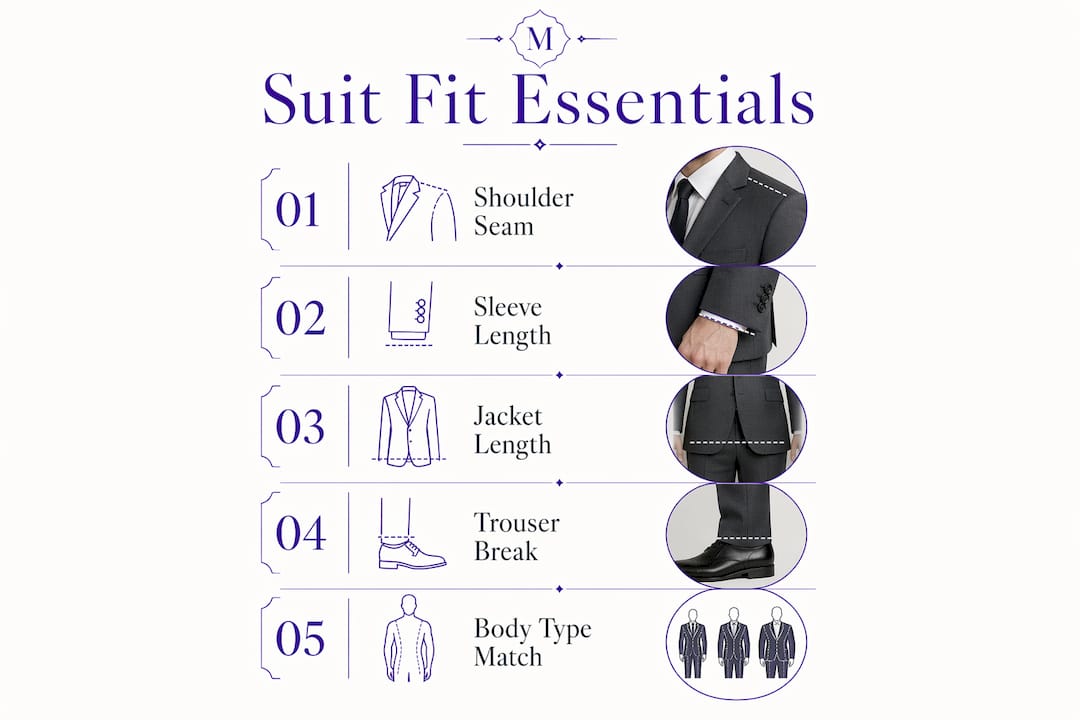
The shoulder seam is the single most important fit point on any jacket. It should sit exactly at the outer edge of your shoulder bone. A seam that falls short of that edge pulls across the chest and makes your chest look narrower than it is. A seam that droops past the bone creates a sloppy, oversized silhouette. Get the shoulder right first. Everything else is adjustable.
Jacket sleeve length
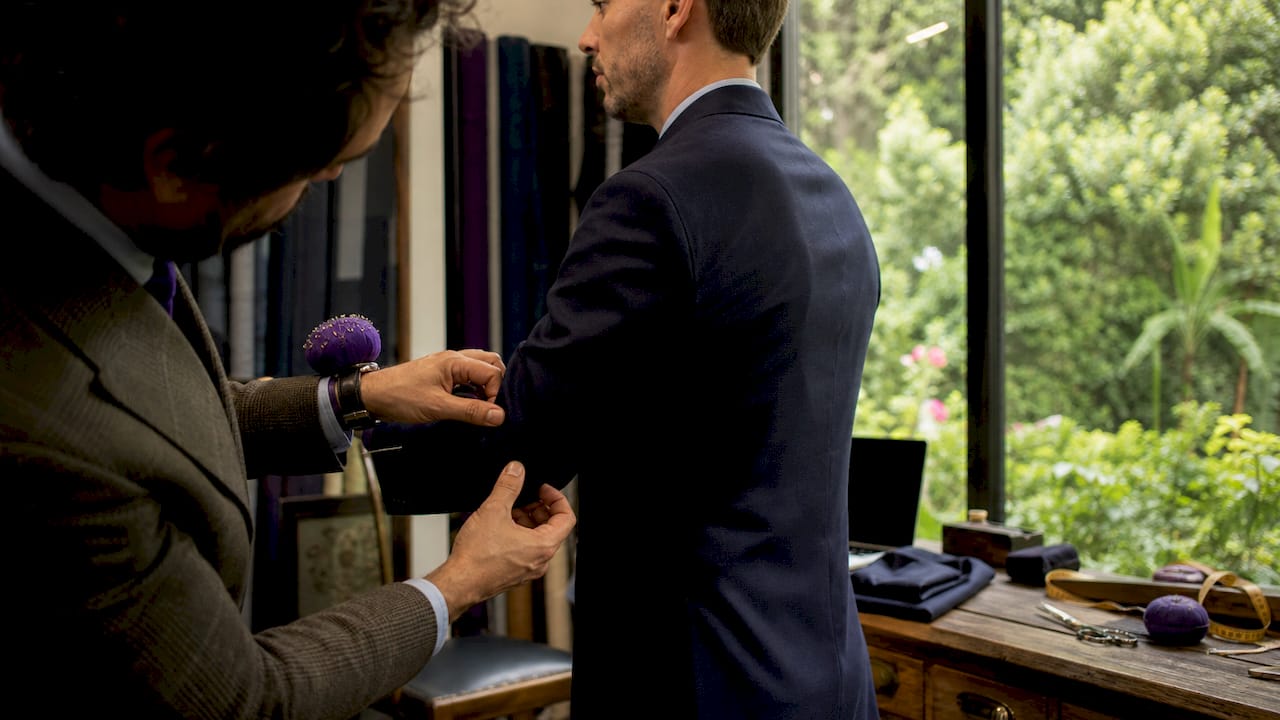
Sleeve length is the detail other people notice most. Your jacket sleeve should end at the base of your thumb joint, showing about a quarter to half an inch of shirt cuff when your arms hang naturally at your sides. That visible cuff is not decoration. It signals that your proportions are dialed in. Specifically, about half an inch of cuff showing beyond the jacket sleeve is the classic standard. More than that looks careless; less looks like you borrowed the jacket.
Jacket length
A jacket that fits in length should cover your seat and end roughly where your fingers curl when your arms hang straight. Shorter jackets read as modern and work well on shorter men. Longer jackets lean traditional and suit taller frames. Neither is wrong, but both need to be intentional.
Trouser break
Trouser break refers to how much fabric folds at the top of your shoe. Your three options are:
- No break: The trouser hem sits just above the shoe. This reads as modern and slim, and works well with slim or tailored fits.
- Half break: A slight fold at the front of the shoe. The half break is the most versatile option for professional and general settings, balancing modern and traditional looks.
- Full break: A noticeable fold of fabric resting on the shoe. This is traditional, and it works best with classic or relaxed fit trousers.
Pro Tip: If you are unsure which break to choose, default to half break. It reads well in business meetings, at weddings, and at dinner without looking like you overthought it.
How to accurately measure yourself for the best suit fit
Measuring yourself correctly at home is straightforward with a soft tape measure, a full-length mirror, and ideally a second person to help. Measuring alone introduces error, especially across the back and shoulders. Here is how to do it right:
- Chest: Wrap the tape around the fullest part of your chest, just under your armpits and across your shoulder blades. Keep the tape snug but not tight. A 42-inch chest measurement corresponds to a size 42 jacket. This is the primary number that determines your jacket size.
- Shoulders: Measure from the outer edge of one shoulder bone to the other, across the back. This number confirms whether a jacket’s shoulder seam will land correctly.
- Sleeve length: Start at the center back of your neck, measure across your shoulder, and continue down to your wrist bone. This gives you your full sleeve length.
- Waist: Measure around your natural waist, which sits above your hips and below your ribcage. Suit pants should sit at the natural waist, not the hips, to preserve the silhouette and avoid bunching.
- Inseam: Measure from your crotch to the bottom of your ankle bone. This determines trouser length before any break adjustment.
- Jacket length: Measure from the base of your neck, at the center back, straight down to where you want the jacket to end.
The most common mistake men make is measuring over thick clothing. Always measure over a dress shirt or nothing at all.
Pro Tip: Write your measurements down and bring them to any store or tailor. Most men’s suit size guides use chest as the primary number, but having all six measurements prevents surprises at the fitting.
How to choose the best suit fit style for your body type
Suit fit styles fall into four main categories. Understanding each one helps you match the right cut to your frame and the occasion.
| Fit Style | Description | Best For |
|---|---|---|
| Slim fit | Narrow through the chest, waist, and trousers | Lean or shorter builds; modern events |
| Tailored fit | Slightly more room than slim, still structured | Athletic builds; business and formal wear |
| Classic fit | Relaxed through the chest and waist | Larger builds; traditional settings |
| Modern fit | Between classic and tailored; clean lines | Most body types; versatile occasions |
Matching fit to body type
Athletic builds, meaning broad shoulders and a defined waist, work best in tailored fit jackets. The extra room through the chest prevents pulling, while the tapered waist keeps the silhouette clean. Slim fit often pulls across the back on athletic frames, which defeats the purpose.
Lean or slim builds benefit from slim fit cuts. The closer construction adds visual structure and prevents the jacket from swallowing the frame. Pairing a slim fit jacket with no-break trousers creates a sharp, modern proportion.
Larger or broader builds are best served by classic or modern fit jackets. These cuts provide comfort without sacrificing structure. Avoid slim fit if the jacket buttons pull or gap at the chest.
Matching fit to occasion
- Business settings: Tailored or modern fit in navy, charcoal, or gray. Half break trousers.
- Formal events: Tailored fit with no break or half break trousers for a clean line.
- Business casual: Modern fit with slightly relaxed trousers. Check out polished casual wardrobe ideas for pairing suits with less formal pieces.
- Cocktail or social events: Slim or tailored fit. For a look at how classic and contemporary fits compare in social settings, formal expression for men offers useful context.
Trouser break also signals formality. No break reads as fashion-forward and modern. Full break reads as traditional and conservative. Half break works across almost every setting.
Common fit issues and how to fix them
Knowing what bad fit looks like is just as useful as knowing what good fit looks like. Here are the problems that show up most often and what to do about them.
- Shoulder seam too short: The jacket pulls across the chest and restricts arm movement. This cannot be fixed by a tailor without rebuilding the shoulder. Size up.
- Sleeve too long: The cuff covers your hand and hides your shirt. A tailor can shorten sleeves in about a week for a modest cost. This is one of the easiest alterations.
- Sleeve too short: The jacket looks borrowed. Lengthening sleeves is possible only if the jacket has enough seam allowance, which is not guaranteed on off-the-rack suits.
- Trouser break too long: Excess fabric pools at the shoe and looks sloppy. A tailor can hem trousers in a single visit.
- Jacket waist too loose: The jacket billows and loses its shape. A tailor can take in the waist seam to restore structure.
When you are between sizes, sizing up is the right call. Shoulders are the hardest part of a jacket to alter. A tailor can bring in the waist, shorten sleeves, and adjust the hem, but rebuilding a shoulder seam is expensive and sometimes impossible. Always prioritize shoulder fit when choosing your size.
Pro Tip: When shopping off the rack, try the jacket first with the shoulder seam as your guide. If the shoulders fit, almost everything else is fixable. If they do not, move to the next size.
The choice between off-the-rack and bespoke comes down to budget and how often you wear suits. Off-the-rack suits from quality retailers, combined with targeted tailoring, deliver excellent results for most men. Bespoke suits, built from scratch to your measurements, make sense if you wear suits daily or have a body type that standard sizing does not accommodate well.
Key takeaways
A well-fitted suit depends on shoulder seam placement above all else, with sleeve length, jacket length, and trouser break each contributing to a complete and polished silhouette.
| Point | Details |
|---|---|
| Shoulder seam is non-negotiable | It must sit at the outer edge of the shoulder bone; no tailor can fix a wrong shoulder cheaply. |
| Measure chest first | Your chest circumference determines your jacket size; bring all six measurements to any fitting. |
| Half break is the safe default | It works across business, formal, and social settings without looking overdressed or underdressed. |
| Size up when between sizes | Shoulders cannot be easily altered; size up and let a tailor adjust the waist and sleeves. |
| Match fit style to body type | Athletic builds need tailored fit; lean builds suit slim fit; larger builds work best in classic or modern fit. |
Why fit beats the label every time
I have seen men spend serious money on designer suits that looked wrong the moment they put them on, and I have seen men in off-the-rack jackets that looked like they were made for them. The difference was never the fabric or the brand. It was always the fit.
The biggest misconception I run into is that men think buying a more expensive suit solves the problem. It does not. A $2,000 jacket with a drooping shoulder seam looks worse than a $400 jacket that sits correctly. Fit is the foundation. Everything else is secondary.
What tailors know that most men do not is that a well-fitted suit moves with the body without restriction. If you feel like you are wearing the suit rather than the suit wearing you, that is the standard to aim for. It takes one or two fittings to learn your measurements, and after that, shopping for suits becomes much faster and far less frustrating.
Invest the time in getting measured properly. Find a tailor you trust. Then buy the best quality you can afford, because once the fit is right, quality fabric and construction will last for years.
— Giuseppe
Dress the part with Moreciandco
Moreciandco is built on one principle: you should get exactly what you pay for, in quality and in experience. Once you know your measurements and the fit style that works for your frame, the next step is pairing that knowledge with pieces worth wearing. The Complesso Collection brings together luxury clothing built for men who take their appearance seriously. For accessories that complete a polished look, the Moreciandco accessories collection has you covered. Explore the full range at Moreciandco and put your fit knowledge to work.
FAQ
What is the most important fit area on a suit jacket?
The shoulder seam is the most critical fit point. It must sit exactly at the outer edge of the shoulder bone. A misaligned shoulder cannot be corrected without expensive reconstruction.
How much shirt cuff should show below a jacket sleeve?
About a quarter to half an inch of shirt cuff should be visible when your arms hang naturally. Half an inch is the classic standard and signals correct sleeve length.
What trouser break works for most occasions?
Half break is the most versatile choice for professional and general settings. It balances a modern look with a traditional one and works across business, formal, and social events.
Should i size up or down if i am between suit sizes?
Size up. Shoulder fit guides your size choice, and shoulders are the hardest part of a jacket to alter. A tailor can adjust the waist and sleeve length far more easily than the shoulder seam.
Can i measure myself for a suit at home?
Yes. You need a soft tape measure and ideally a second person to help. Measure your chest, shoulders, sleeve length, waist, inseam, and jacket length over a dress shirt for accurate results.