


If you want the short answer: goggles, fins, a pull buoy, a snorkel, hand paddles, a tempo trainer, a durable training suit, and a mesh bag all deliver the biggest return on investment for serious swimmers, and the one rule that matters more than any brand name is this: buy for fit and function first, hype second. A $40 pair of goggles that seals properly beats a $90 pair that fogs after one set. A suit that fits your body beats a suit that fits a size chart.
Here’s what each core item actually trains, in plain terms:
- Fins build ankle flexibility and leg strength you can’t get from kicking alone.
- Snorkel locks your head position so you stop lifting to breathe and start feeling real body alignment.
- Paddles overload your pull to build feel for the water and upper-body strength.
- Tempo trainer hardwires stroke rate and rhythm so pacing becomes automatic, not guesswork.
- Pull buoy isolates your upper body so you can focus purely on catch and pull mechanics.
If you’re chasing technique, start with the section on gear essentials below. If you’re after raw power, jump to the decision framework. If endurance and durability are your priority, go straight to maintenance and lifespan, because gear that dies early is the most expensive gear you’ll ever own.
Key Takeaways
Choosing quality swim training gear comes down to matching fit and function to a clear training goal, then maintaining that gear well enough to get its full usable life.
| Point | Details |
|---|---|
| Prioritize fit over hype | A properly fitted, mid-priced item outperforms an ill-fitting premium one every time. |
| Match gear to your goal | Technical work calls for a snorkel and tempo trainer; power work calls for paddles and bands. |
| Cap tool-heavy volume | Keep any single resistance tool under roughly a third of weekly training volume. |
| Rinse and dry after every session | This single habit does more to extend gear lifespan than any product choice. |
| Retire gear on schedule | Replace goggles every three to six months and suits after regular prolonged use. |
| Test-fit before buying | Run a goggle leak test and check fin heel fit in the water, not just in the store. |
Table of Contents
- What Swim Training Gear Do You Actually Need?
- How Do You Match Gear to Your Training Goal?
- How Long Does Swim Gear Actually Last?
- Which Specific Models Are Worth Buying?
- What Do Experienced Coaches Actually Trust?
- Ready to Round Out Your Training Kit?
- Where to Learn More About Swim Training and Gear Care
- Frequently Asked Questions
- Sources
What Swim Training Gear Do You Actually Need?
Every serious swim program builds around a short list of tools, and consumer roundups covering essential swim gear consistently land on the same ten items. What separates a good purchase from a wasted one isn’t the brand on the box. It’s whether the item fits your body, resists chlorine breakdown, and does the specific job you bought it for.
Goggles are non-negotiable and the easiest place to waste money. Their job is simple: give you a clear, leak-free view without pressure headaches during a two-hour session. Quality signals include a silicone gasket that molds to your eye socket, UV-coated or anti-fog lenses that actually hold up past week three, and an adjustable nose bridge. Speedo goggles remain a widely available benchmark for training-focused fit, particularly their Vanquisher line, which swimmers use for its wider peripheral seal. Buy the wrong size and you’ll spend more time adjusting than swimming.
Swim caps protect hair and reduce drag, and the material matters more than most swimmers realize. Silicone caps last longer and grip better than latex, though latex is cheaper and fine for casual training. Skip anything that pinches at the temples after ten minutes.
Training suits need to survive daily chlorine exposure without losing compression or color within a month. Chlorine-resistant fabric blends (polyester-heavy over pure Lycra) hold shape significantly longer. This is not the suit to save money on if you’re swimming five or six days a week.
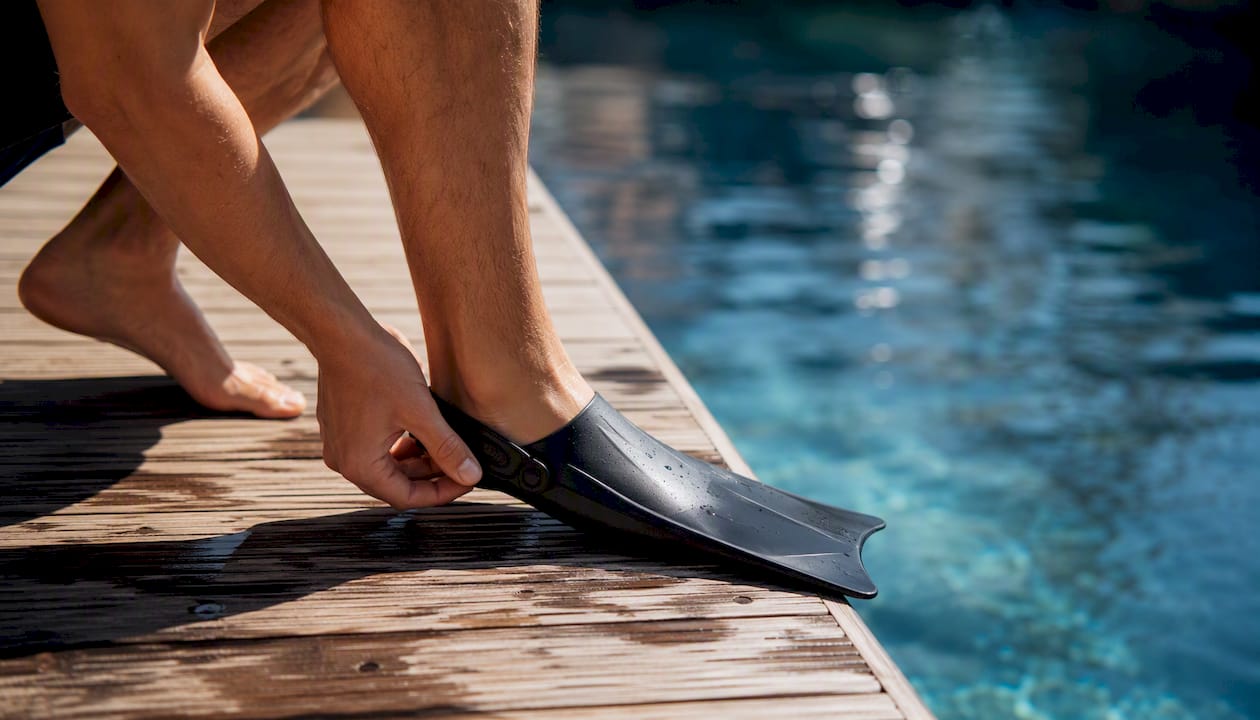
Fins train ankle flexibility, kick power, and body position simultaneously. Short-blade training fins work best for technical work; long-blade fins build raw leg strength but can mask poor technique if overused. Check heel fit in the store or at the pool edge before committing. A fin that’s too tight causes cramping; too loose causes blisters and slippage.
Kickboards isolate the legs for pure kick sets. Contoured foam boards that match your torso width reduce shoulder strain during long kick sets, which matters more than people expect once you’re doing 800 meters of kick work.
Pull buoys sit between your thighs to float your legs and isolate upper-body pull. Eney makes widely available foam pull buoys that hold shape after repeated compression, which matters because cheap foam buoys flatten out within a season and stop doing their job.
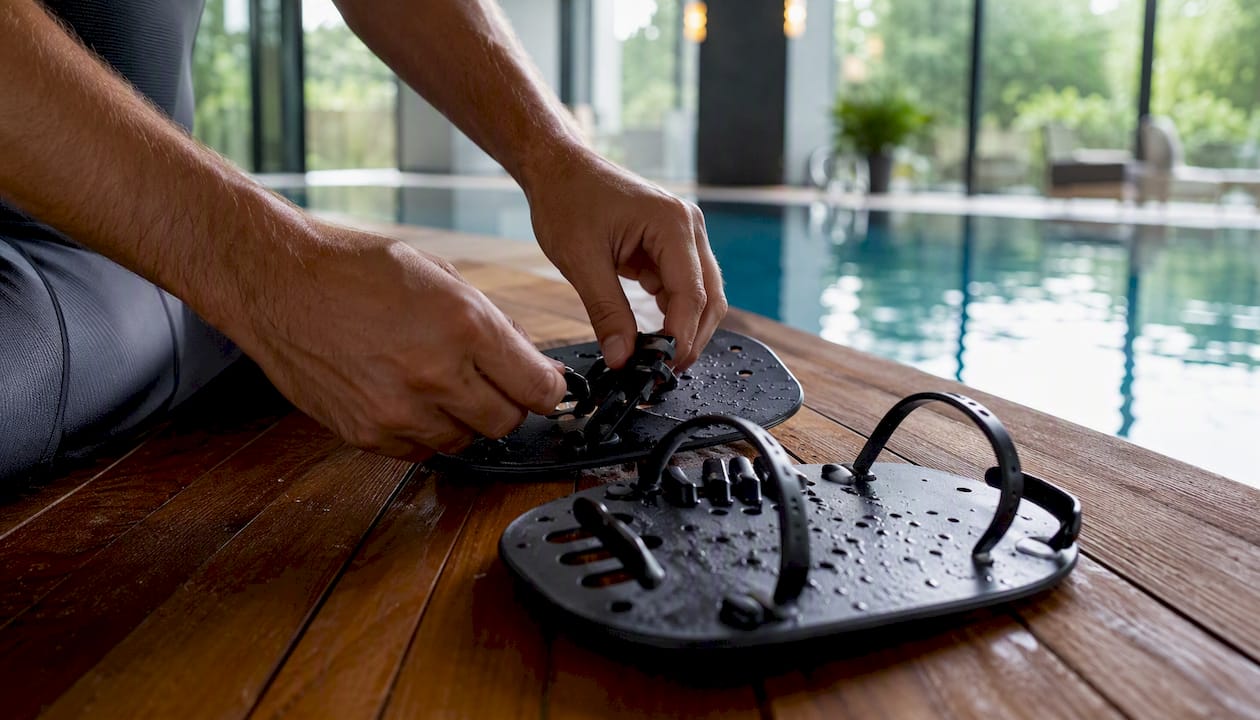
Hand paddles add resistance to build pull strength and water feel. Sizing here is critical. Oversized paddles strain the shoulder joint and encourage a shorter, choppier stroke. Speedo’s paddle line offers graduated sizing that lets swimmers scale up gradually rather than jumping straight to a size built for someone twice their strength.
Snorkels remove the breathing variable so you can focus entirely on head position and rotation. Center-mount snorkels, like those from FINIS, are the training standard because they don’t create the asymmetrical drag a side-mount model does. Comfort at the mouthpiece and a purge valve that clears water fast are the two features worth checking before buying.
Tempo trainers are small waterproof metronomes that clip to a cap or goggle strap and beep at a set interval, training stroke rate consistency. The FINIS Tempo Trainer Pro is the model most competitive programs default to, largely because it’s waterproof to depth and easy to program poolside.
Mesh bags seem like an afterthought until your gear starts smelling or your goggles crack from being crushed at the bottom of a gym bag. Ventilated mesh keeps everything dry between sessions, which directly affects how long the rest of your gear lasts.
Misuse is where most of this goes wrong. Overusing paddles trains bad shoulder mechanics and can lead to overuse injuries, a real concern supported by research on training load and injury risk in swimmers. Overusing fins can mask a weak kick instead of fixing it. The fix isn’t avoiding these tools. It’s using them with a purpose and pulling them out of your bag once that purpose is served, a philosophy echoed in coach-recommended training tool guidance.
Pro Tip: Do a “leak test” on goggles before you ever get in the water: press them gently to your eye sockets without using the strap. If they hold suction for two or three seconds, the seal is good. If they fall off immediately, that model isn’t shaped for your face, no matter how many good reviews it has.
| Item | Primary Training Purpose | Ideal Skill Level | Top Quality Feature to Check |
|---|---|---|---|
| Goggles | Clear vision, comfort under repetition | All levels | Silicone gasket seal |
| Fins | Ankle flexibility, kick power | Beginner to advanced | Heel fit and blade flexibility |
| Pull buoy | Upper-body isolation | All levels | Foam density retention |
| Hand paddles | Pull strength, water feel | Intermediate to advanced | Graduated sizing |
| Snorkel | Body position, breath control | Intermediate to advanced | Center-mount stability |
| Tempo trainer | Stroke rate consistency | Intermediate to advanced | Waterproof depth rating |
If you’re building a full training kit rather than one item at a time, our durability checklist for athletic wear covers the same material-quality principles that apply to swim gear, since chlorine and repeated washing punish fabric the same way sweat does.
How Do You Match Gear to Your Training Goal?
The fastest way to waste money on swim gear is buying based on what’s trending instead of what your training actually needs. A repeatable decision flow solves that.
- Define your primary goal. Technical refinement, raw power, or speed and flexibility each point toward a different toolkit.
- For technical refinement, prioritize a snorkel, moderate-sized paddles, and a tempo trainer. These three tools isolate different pieces of your stroke without overwhelming your body’s natural feel for the water.
- For power development, paddles, drag shorts or a parachute, and resistance bands from a brand like Sporti build strength against water resistance. Sporti’s training accessories are widely stocked at team stores and give swimmers an affordable entry point into resisted training.
- For speed and ankle flexibility, fins are your highest-leverage purchase. Short-blade fins in particular train the kick without letting you coast on the extra propulsion long-blade fins provide.
- Cross-check against your budget tier before buying anything else.
Budget tiers break down roughly like this. Entry-level ($15 to $40 per item) covers goggles, a basic mesh bag, and a kickboard. This tier gets a beginner or intermediate swimmer through most of a season without gaps. Mid-tier ($40 to $90 per item) covers a quality pull buoy, a center-mount snorkel, and a tempo trainer, the three items that most reliably improve technique regardless of skill level. Premium ($90 and up) covers advanced paddle sets, drag equipment, and dryland tools, gear that pays off only once your technique is solid enough to load resistance without reinforcing bad habits.
Watch for two common overbuying traps. First, tech suits for routine training. Competition-grade tech suits are built for a handful of meets a year, not daily practice, and they degrade fast under regular chlorine exposure. Second, oversized paddles bought “to grow into.” A swim equipment guide focused on genuine performance value warns against any single tool dominating your weekly volume, and oversized paddles are the most common way swimmers violate that rule without realizing it.
| Training Goal | Top 2-3 High-Impact Items | Risk of Misuse |
|---|---|---|
| Technical refinement | Snorkel, tempo trainer, moderate paddles | Becoming dependent on the snorkel for air awareness |
| Power development | Paddles, resistance bands, drag shorts | Shoulder strain from oversized paddles |
| Speed and flexibility | Short-blade fins, long-blade fins | Kick technique degrading without fin support |
Before you commit to a purchase, run these fit checks in the pool, not the store:
- Do the goggle leak test described earlier, then repeat it after ten minutes of swimming to check for slow leaks under strap pressure.
- Test snorkel comfort during an actual set, not just a still-water dunk, since jaw fatigue only shows up under repeated breathing cycles.
- Check fin heel fit by kicking a 25 at moderate effort. If your heel slips even slightly, size down.
How Long Does Swim Gear Actually Last?
Chlorine is the single biggest reason swim gear dies early, and most swimmers underestimate how much a simple rinse-and-dry habit changes lifespan. A breakdown of chlorine’s effect on synthetic swim materials confirms that rinsing gear immediately after each session and letting it dry fully before storage meaningfully slows fabric degradation.
Here’s the maintenance routine that actually moves the needle:
- Rinse every item in fresh water immediately after your session to significantly reduce chlorine damage to the fibers.
- Air-dry everything away from direct sunlight and away from heaters or car dashboards, since heat breaks down silicone and elastane faster than chlorine alone.
- Store dry gear in a ventilated mesh bag, never a sealed plastic bag, which traps residual moisture and speeds up material breakdown.
- Replace goggles once the gasket loses its seal, typically within a few months of regular use.
- Replace training suits once compression noticeably loosens, generally after regular prolonged use of daily-use fabric blends.
Paddles and fins last considerably longer than suits and goggles since they’re rigid plastic rather than stretched fabric, but check strap elastic regularly since that’s the first part to fail. A tempo trainer’s main failure point is the battery seal, so rinse it but don’t soak it.
Pro Tip: After practice, turn your training suit inside out before hanging it to dry. This exposes the inner lining, where sweat and chlorine residue concentrate, to more airflow and cuts drying time significantly, which matters if you’re swimming twice a day and only have one suit in rotation.
Recovery and training load also factor into how hard you should push tool-heavy sets. Research on training adaptations and recovery in athletes supports spacing high-resistance paddle or band work with adequate recovery, rather than stacking heavy tool use every session, which is as much about protecting your gear’s lifespan as your shoulders.
Which Specific Models Are Worth Buying?
You don’t need to buy every model on the market. You need the right one for where you are in your training right now.
FINIS Agility 2 or Center-Mount Snorkel. Choose this if body position work is your current focus. It suits intermediate to advanced swimmers who already have solid basic technique and want to isolate stroke mechanics. Buying tip: check the mouthpiece size separately from the tube length, since a poorly fitted mouthpiece causes jaw fatigue faster than the tube design ever will.
FINIS Tempo Trainer Pro. This is the standard choice for swimmers working on stroke rate and pacing consistency, and it fits any skill level willing to put in the drill work. Skip it if you’re not ready to swim to a beep for an entire set, since inconsistent use defeats the purpose. Consumer platforms like Swim offer complementary tracking tools if you want to log stroke count alongside tempo data.
Speedo Vanquisher 2.0 Goggles. A reliable entry point for beginners and a dependable backup pair for advanced swimmers. Buying tip: try the mirrored and clear lens versions separately, since indoor pools often favor clear or tinted lenses over mirrored ones.
Speedo Power Plush Paddles. Choose the smaller size first if you’re newer to paddle work. Red flag: buying the largest size available “for faster progress” almost always backfires into shoulder strain within a few weeks.
Eney Pull Buoy. A dependable mid-tier choice for isolating upper-body work, and a good fit for swimmers at any level who want consistent buoy shape over a full season rather than a buoy that flattens out after two months.
Sporti Resistance Bands. A budget-friendly way to add dryland resistance work without a major equipment investment, and a solid fit for swimmers building strength between pool sessions.
Vasa Trainer Pro. For swimmers serious about dryland strength that actually replicates stroke mechanics, the Vasa Trainer is the recognized standard. It’s a bigger investment and makes the most sense for competitive swimmers training multiple times a week, not casual swimmers doing two sessions.
| Model | Skill Level | Price Tier | Training Purpose |
|---|---|---|---|
| FINIS Center-Mount Snorkel | Intermediate to advanced | Mid | Body position, breath control |
| FINIS Tempo Trainer Pro | All levels | Mid | Stroke rate training |
| Speedo Vanquisher 2.0 | Beginner to advanced | Entry | Vision and comfort |
| Speedo Power Plush Paddles | Beginner to intermediate | Entry to mid | Pull strength |
| Eney Pull Buoy | All levels | Entry to mid | Upper-body isolation |
| Sporti Resistance Bands | All levels | Entry | Dryland resistance |
| Vasa Trainer Pro | Advanced | Premium | Dryland stroke-specific strength |
What Do Experienced Coaches Actually Trust?
The swimmers who improve fastest aren’t the ones with the most gear. They’re the ones who use the right tool at the right moment and then take it off. A snorkel earns its place in a warmup set focused on rotation, then comes off for the main set so the swimmer proves they can hold that position unassisted. A tempo trainer works the same way: clip it on for a technical set, remove it, and see if the rhythm holds without the beep. That transfer test tells you more about actual progress than any amount of time spent wearing the tool.
Two habits separate swimmers who improve efficiently from swimmers who plateau. First, cap paddle-set volume. A commonly recommended ceiling is keeping paddle work under a moderate portion of total pull volume in a given week, since heavier use tends to reinforce shoulder-dominant strokes rather than correcting them. Second, treat the tempo trainer as a diagnostic tool, not a permanent crutch: use it for two or three sets per session, then swim the same interval unassisted to check whether the rhythm actually stuck.
Coaching standards published through organizations like Swimmingcoach reflect this same philosophy: tools should sharpen a specific skill, then get removed so the swimmer can prove they’ve internalized it. That’s the difference between gear that builds you up and gear that quietly becomes a permanent dependency. Moreciandco built this guide around that same principle, treating gear selection as a functional decision rather than a marketing one, which is also why our own performance apparel guidance leans on fit and material quality over branding.
Ready to Round Out Your Training Kit?
Swim-specific gear gets you through the water, but what you wear before and after practice matters more than most swimmers admit. Chlorine-damp cotton tees sitting in a gym bag all day breed odor and break down fast, which is exactly the kind of premature wear this guide has been warning you about. Moreciandco’s bamboo-cotton Complesso Tee is built from a blend that resists that kind of breakdown far better than standard cotton, making it a smart pick for the drive to and from the pool. If you’re assembling a full rotation of durable training and post-practice pieces, the Complesso Collection and the wider Moreciandco lineup apply the same fit-first, quality-first philosophy this article has walked through for pool gear, just applied to what you wear on land.
Where to Learn More About Swim Training and Gear Care
Swimmers who want to dig deeper into the research and coaching standards behind this guide have a few solid places to start.
- The dirty truth about chlorine, sweat and your swim gear breaks down exactly how chlorine degrades synthetic fabrics and why rinsing matters more than most swimmers assume.
- The Best Swim Training Tools for Triathletes offers a coach’s view on which tools deliver real value and how to avoid overusing them.
- The Ultimate Guide to Swimming Equipment: What Actually Works is useful for budget planning and separating genuinely useful gear from items that underdeliver.
- SwimmingCoach.org publishes coaching resources worth reviewing if you want to understand how competitive programs structure tool-based drills.
“The tools that actually move the needle are the ones used with a specific purpose, then taken away so the swimmer has to prove the skill stuck.” That’s the throughline across every serious coaching resource on training equipment, and it’s the single best filter to run any gear purchase through before you buy.
Frequently Asked Questions
What brands make the best swim training gear? FINIS, Speedo, Sporti, and Eney are among the most widely available and trusted names across snorkels, goggles, paddles, resistance accessories, and pull buoys. No single brand covers every category best, so match the specific model to the specific quality checklist for that item rather than shopping by brand loyalty alone.
What gear actually improves swim performance the fastest? A center-mount snorkel paired with a tempo trainer produces the fastest technical gains for most swimmers, since both target stroke mechanics and rhythm directly rather than just adding resistance.
Does the 80/20 rule apply to swim training gear? Loosely, yes.
How do I know if my goggles fit correctly? Press them gently against your eye sockets without the strap. If they hold suction for two or three seconds without falling, the seal fits. If water seeps in during a leak test after ten minutes of swimming, size down or try a different gasket shape.
Is it safe to use paddles and fins every session? No. Using either every session raises the risk of shoulder or ankle strain over time. Cycle them into specific sets rather than full workouts, and always follow a tool-assisted set with an unassisted one to confirm the technique holds without help.
This article provides general training and equipment guidance and is not a substitute for advice from a certified swim coach or medical professional, particularly if you’re managing an existing injury.
Sources
- The dirty truth about chlorine, sweat and your swim gear
- The Best Swim Training Tools for Triathletes: Our Favorites — Triathlete
- The Ultimate Guide to Swimming Equipment: What Actually Works
- PubMed entry (27373807)