


Every man heading out for a regular run needs the same short list: a well-fitting pair of running shoes, moisture-wicking socks, a technical top and shorts or tights, a hydration option scaled to run length, and a reflective element or light for low-visibility conditions. That is the core. Everything else is an upgrade you add as your mileage grows.
Here is the quick must-have list before you read further:
- Running shoes (daily trainer, fitted properly)
- Technical socks (synthetic or merino, not cotton)
- Moisture-wicking top (short-sleeve or long-sleeve depending on weather)
- Running shorts or tights
- Hydration (nothing for runs under 30 minutes in mild weather; a handheld or belt for anything longer or hotter)
- Phone or ID (always)
- Reflective gear or clip-on light (any run near traffic or in low light)
For runs under 60 minutes, that seven-item list is your complete kit. For long runs over 90 minutes, add a nutrition source, a carry system, and a blister kit. The sections below explain how to choose each item, what to spend, and how to pack by run length.
Pro Tip: Never wear brand-new shoes on a run longer than 20 minutes. Break them in on two or three short outings first so you catch fit problems before they become blisters on a long run.
Key Takeaways
A complete men’s running gear checklist starts with shoes, socks, and moisture-wicking apparel, then scales carry systems and nutrition to run length.
| Point | Details |
|---|---|
| Shoes come first | Start with a comfortable daily trainer; replace it at 300–500 miles before cushioning fails. |
| Ditch cotton immediately | Synthetic or merino socks and tops reduce blisters and chafing on every run. |
| Scale your carry to distance | Short runs need almost nothing; runs over 90 minutes need a vest, nutrition, and a blister kit. |
| Safety is not optional | A reflective element and a light are required for any run near traffic or in low light. |
| Moreciandco for easy runs | The Complesso Tee and Cappellino cap fit short recovery runs and off-run wear with quality materials. |
Table of Contents
- What belongs on your men’s running gear checklist?
- How do you choose the right running shoes?
- Why do socks and underwear matter for running?
- What should you wear for running?
- What outerwear do you need for cold-weather running?
- How much water do you need on a run?
- What is the best way to carry your gear on a run?
- Do you need a GPS watch, or will your phone do?
- How do you stay safe on a run?
- Where should you spend and where can you save?
- How do you take care of your running gear?
- What does the evidence say about hydration and fueling?
- A 10K vs. a 20-mile training day: what actually changes in your pack
- Quality basics that work for your training rotation
- Sources
What belongs on your men’s running gear checklist?
Must-haves vs. nice-to-haves
Must-haves (buy these first):
- Running shoes (daily trainer)
- Technical running socks (3+ pairs)
- Moisture-wicking short-sleeve top
- Running shorts with a liner, or tights
- Reflective vest or clip-on light
- Phone holder or ID card
- Hydration option (handheld bottle or belt for runs over 30 minutes)
Nice-to-haves (add as you build mileage):
- GPS running watch
- Running jacket (water-resistant)
- Compression base layer
- Trail shoes (if you run off-road)
- Bone-conduction headphones
- Running cap or visor
- Anti-chafe balm (BodyGlide)
- Foam roller for recovery
Packing by run length
| Run Length | What to Carry |
|---|---|
| Short (<45 min) | Shoes, socks, top, shorts, phone/ID, reflective clip |
| Medium (45–90 min) | Above + handheld bottle or belt, electrolyte tab |
| Long (>90 min) | Above + running vest, gels or chews, blister kit, emergency contact card |
Pro Tip: Test any new piece of gear on a short run first. A chafing waistband or a slipping phone armband is a minor annoyance at 20 minutes and a real problem at mile 12. The running gear buying guide on Moreciandco covers fit principles worth reading before you buy.
How do you choose the right running shoes?
Shoes are the single most important purchase in your running kit. Get them wrong and nothing else matters. The Running Channel puts it plainly: start with a comfortable daily trainer and add specialized shoes later. That advice holds whether you are logging three miles a week or thirty.
Fit checklist
Before you buy, check these five things:
- Length: About a thumb’s width between your longest toe and the end of the shoe.
- Width: No pinching across the forefoot; the shoe should hold your foot without squeezing it.
- Heel hold: Your heel should not slip when you walk or jog in place.
- Toe room: Toes should be able to splay slightly, not curl or press against the upper.
- Arch feel: The shoe should feel supportive underfoot without creating pressure points.
Try shoes on in the afternoon when your feet are slightly swollen from daily activity. If you are buying online, use a brand’s fit guide and check the return policy before ordering.
Shoe types and when each makes sense
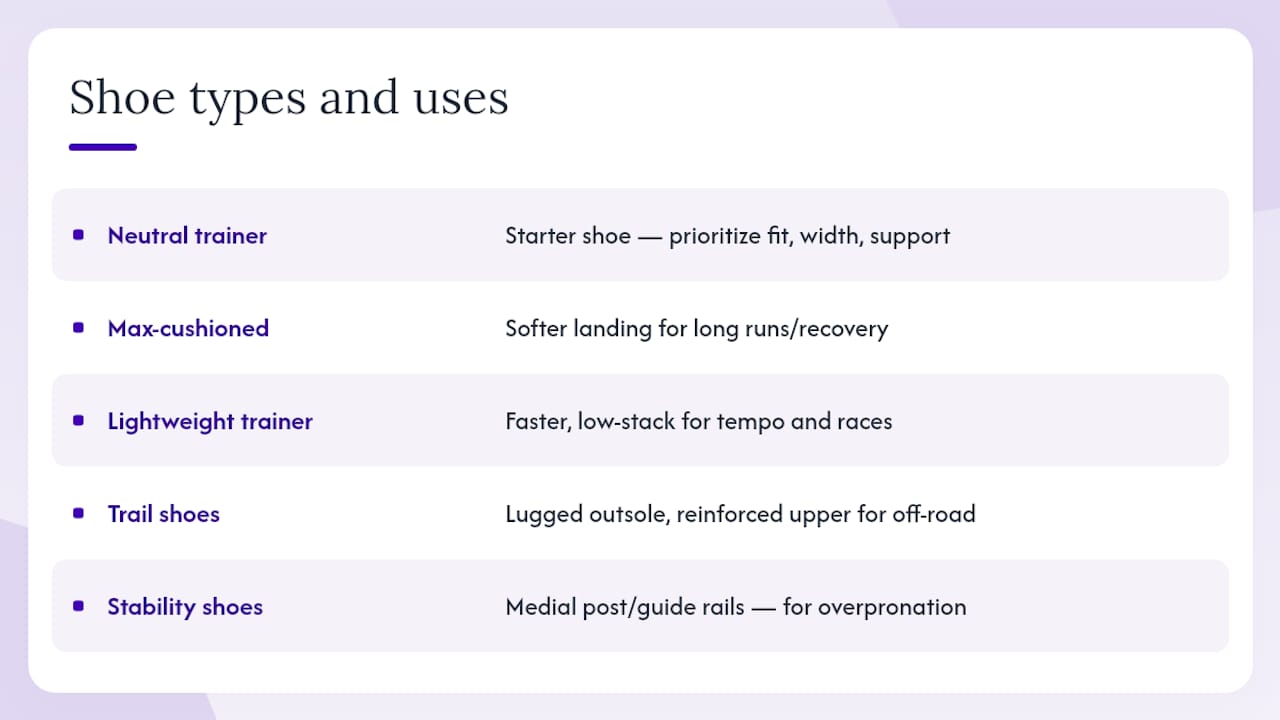
Neutral daily trainer: The right starting point for most men. Models like the Brooks Ghost, ASICS Novablast, and Saucony Ride offer a balance of cushioning and responsiveness that works across paces and distances. Runner’s World testing consistently points to fit, width, and support as the priorities for beginners choosing a trainer.
Max-cushioned shoes: Hoka’s Mach and Speedgoat lines sit at this end of the spectrum. The Mach is a road shoe; the Speedgoat is built for technical trail. Both suit runners who want a softer landing, especially on long runs or recovery days.
Lightweight trainers: Faster, lower-stack shoes for tempo runs and races. Not the right daily driver for most men, but worth adding once you have a base shoe dialed in.
Trail shoes: Lugged outsoles, reinforced uppers, and a lower profile for grip on dirt, rock, and mud. If your runs include any off-road terrain, trail shoes are worth the investment.
Stability shoes: Built with medial post or guide rails to reduce overpronation. Worth considering if a gait analysis at a running specialty store flags significant inward roll.
Minimalist shoes: Low drop, thin stack, little structure. These require a gradual transition and are not a beginner choice.
When to replace your shoes
Running shoes typically last 300–500 miles before the midsole cushioning breaks down enough to affect comfort and injury risk.
Visual signs it is time to retire a pair: the midsole looks compressed or creased when you look at it from the side, the outsole rubber is worn through in patches, or your legs feel noticeably more tired after runs where they did not before. Track your mileage in a running app so you are not guessing.
Pro Tip: Rotate between two pairs of shoes. Cushioning foam needs 24–48 hours to decompress after a run. Rotating extends the life of both pairs and lets you match the shoe to the workout.
Why do socks and underwear matter for running?
Cotton socks are the fastest route to blisters. Swap them for synthetic or merino wool running socks and buy at least three pairs so you always have a clean, dry option. That single change eliminates most blister problems for new runners, according to REI’s running gear guidance.
What to look for in running socks
- Moisture-wicking fabric: Polyester, nylon, or merino wool. All three pull sweat away from skin faster than cotton.
- Seamless or flat toe seam: Reduces friction at the toe box, where most blisters start.
- Cushioning zones: Light cushioning under the ball and heel absorbs impact without adding bulk.
- Height: Ankle socks work for most road runs. Crew height adds protection against trail debris and shoe collar rub.
Balega is a widely trusted name in running socks, with options ranging from ultra-light to heavily cushioned. Their Hidden Comfort and Blister Resist lines are popular for good reason: the fit is snug without being tight, and the fabric holds up after dozens of washes.
Underwear and liners
Most running shorts include a built-in liner, which is enough for most men on most runs. If you prefer to wear underwear underneath, choose a brief or boxer-brief cut in a moisture-wicking fabric (polyester or nylon). Avoid anything with thick seams at the inner thigh. Chafing in that area compounds fast on longer runs.
Pro Tip: If you have a known blister hotspot, apply a small piece of Leukotape or Moleskin before the run, not after. Preventive taping takes 30 seconds and saves you from a painful week of recovery.
What should you wear for running?
Prioritize moisture-wicking performance fabrics and a fit that does not restrict your stride. Style is secondary. REI’s expert advice on running apparel is direct: technical fabrics manage sweat and reduce chafing; cotton holds moisture against your skin and creates friction. That gap matters most on runs over 30 minutes or in warm weather.
Tops
Short-sleeve technical tee: Your workhorse piece. Look for flatlock seams (they lie flat against skin), a slightly athletic cut that does not flap, and a fabric with at least some stretch. Polyester blends dominate this category for a reason: they dry fast and hold their shape. For guidance on venting and airflow features in performance shirts, Moreciandco’s guide breaks down what actually matters.
Long-sleeve top: For cooler weather or sun protection on trail runs. Merino wool options are worth the price if you run in variable temperatures; they regulate warmth better than synthetics and resist odor longer.
Compression base layer: Useful under a jacket in cold weather or as a standalone top for high-output intervals. Tight fit, four-way stretch, and moisture management are the features to check.
Bottoms
Running shorts: The default for most men in warm weather. A 5-inch or 7-inch inseam with a built-in liner covers most situations. Longer inseams reduce inner-thigh chafing on longer runs. For a breakdown of short styles and liner options, Moreciandco’s guide is worth a read before you buy.
Half-tights (compression shorts): Good under loose shorts for chafe prevention, or as a standalone in mild weather.
Full tights: For temperatures below about 45°F. Thermal-lined tights add meaningful warmth without bulk.
Seasonal layering
| Layer | Purpose | When to Use |
|---|---|---|
| Base layer (moisture-wicking tee or compression top) | Moves sweat away from skin | All temperatures |
| Mid layer (fleece or thermal long-sleeve) | Adds warmth, retains breathability | Below 40°F |
| Shell (water-resistant running jacket) | Blocks wind and light rain | Rain, wind, or below 40°F |
A note on Moreciandco’s bamboo-cotton tees: The Complesso Tee is a genuinely comfortable piece for easy, low-sweat runs and warm-up walks. Bamboo-cotton blends breathe well and feel soft against skin. For short recovery runs or cool-down walks, it works. For long runs or high-output sessions in heat, a dedicated technical fabric will manage sweat faster. Use it where it fits, and reach for a performance synthetic when the pace or distance goes up.
What outerwear do you need for cold-weather running?
Pick a lightweight, breathable, water-resistant running jacket over a fully waterproof shell for most runs. REI’s running gear experts make this point clearly: fully waterproof shells trap sweat and overheat you on anything but a slow, cold, wet run. A DWR-treated (durable water repellent) running jacket handles light rain and wind without cooking you from the inside.
Cold-weather accessories
- Running beanie or thermal hat: Covers ears and retains heat. Wear it below 40°F.
- Running gloves: Lightweight, touchscreen-compatible gloves for 30–45°F. Thicker mittens for below 20°F.
- Neck gaiter: Pulls double duty as a face covering in wind or extreme cold. More versatile than a scarf.
- Microspikes or traction devices: Slip over your running shoes for icy roads or trails. Worth owning if you run through winter in a northern state.
The dressing rule of thumb
Dress as if it is 10–15°F warmer than the actual temperature. Your body heat will close that gap within the first mile. If you step outside and feel perfectly comfortable, you are overdressed. You should feel slightly cool at the start of a run. For a full breakdown of cold-weather layering, Moreciandco’s winter training guide covers specific piece combinations by temperature range.
Pro Tip: Wear gloves and a hat before you think you need them. Hands and ears lose heat fast in wind, and once they go numb, your form suffers. You can always stuff gloves in a pocket at mile two.
How much water do you need on a run?
Short runs in mild weather need nothing. Once you cross 30–45 minutes, or if the temperature is above 70°F, carry water. For runs over 90 minutes or in heat, add electrolytes. That is the practical rule, and it aligns with sports science guidance on hydration for prolonged exercise.
Carry options
- Handheld bottle: The Salomon Active Handheld is a well-regarded option. Holds 17 oz, has a hand strap so you are not gripping it, and fits a gel or key in the pocket. Best for medium runs where you want quick access to water.
- Running belt: Holds one or two soft flasks plus a phone and keys. Lower profile than a vest. Good for road runs up to about two hours.
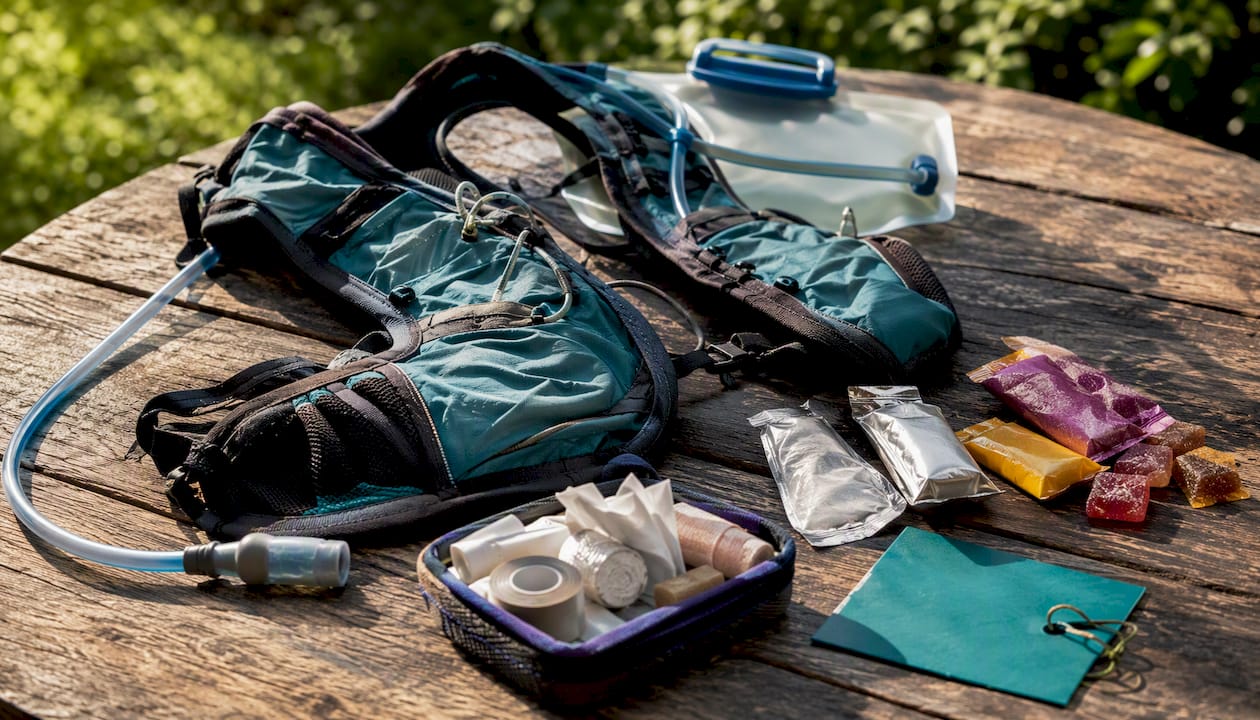
- Running vest: The choice for trail runs and anything over two hours. Carries 1–2 liters of fluid plus nutrition, layers, and a first-aid kit. More setup but worth it for long days.
Fueling basics
- Under 60 minutes: Water only, if anything.
- 60–90 minutes: 30–60g of carbohydrates per hour. A gel or two chews every 30–45 minutes works for most men.
- Over 90 minutes: Carbohydrates plus electrolytes (sodium, potassium, magnesium). Electrolyte tabs or drink mixes added to your water are the simplest approach.
Real-food options (dates, banana pieces, rice cakes) work well for men who find gels hard on the stomach. The timing matters more than the format: get carbohydrates in before you feel depleted, not after.
Sports science reviews emphasize that electrolyte management and timed carbohydrate intake directly influence comfort and performance in prolonged or hot-weather runs.
What is the best way to carry your gear on a run?
Choose the lightest carry system that holds everything you need for the run length. A vest for a 20-minute road run is overkill. A belt for a 4-hour trail run is not enough. Running accessories like belts and hydration solutions meaningfully improve comfort when matched to the right distance and terrain.
Belt vs. vest vs. armband
- Running belt: Low profile, holds phone, keys, one or two soft flasks. Best for road runs up to 90 minutes. Minimal bounce when fitted snugly.
- Running vest: High capacity, distributes weight across chest and back. Best for trail runs, long runs, and any outing where you carry layers, nutrition, and a first-aid kit.
- Phone armband: Holds phone only. Lightweight and simple for short runs. Can cause arm fatigue on longer outings and tends to slip on sweaty skin.
What to pack by run length
Short run (<45 min): Phone or ID, house key, one gel if you are prone to bonking, reflective clip.
Medium run (45–90 min): Above plus a handheld or belt with water, electrolyte tab, blister kit (two Moleskin squares and a small piece of tape).
Long run (>90 min): Above plus running vest, 2–3 gels or equivalent, emergency contact card, small first-aid kit (bandages, antiseptic wipe, pain reliever), extra layer if weather is variable.
Phone handling: Keep your phone in a waterproof case or a ziplock bag inside your belt on wet days. Download offline maps before trail runs. Keep the battery above 50% before you leave.
Do you need a GPS watch, or will your phone do?
A basic GPS watch or a free running app on your phone is enough to track pace, distance, and progress. Buy advanced features only if you will actually use them. Most men starting out get everything they need from Strava or Nike Run Club on their existing phone.
Watch vs. phone tracking
- GPS watch pros: Dedicated battery life (20+ hours on some models), wrist-based heart rate, no phone to carry, faster GPS lock.
- GPS watch cons: Upfront cost ($250–$600 for a solid mid-range model), one more device to charge.
- Phone pros: Already in your pocket, free apps, no extra cost.
- Phone cons: Battery drain, bulkier to carry, screen can be hard to read mid-run.
The Garmin Forerunner line (the Forerunner 955 is a popular mid-range choice) offers reliable GPS, multi-sport tracking, and long battery life. It is a worthwhile investment once you are running consistently and want data beyond basic pace and distance.
Headphones and safety
Bone-conduction headphones like the Shokz OpenRun sit outside the ear canal, leaving your ears open to traffic, cyclists, and other runners. For road running, that is a meaningful safety advantage over in-ear options that block ambient sound. Sound quality is slightly lower than premium in-ear headphones, but the tradeoff is worth it for most outdoor runs.
Pro Tip: Test new headphones on a short run before committing to them on a long one. Fit issues, cable bounce, and connectivity drops are all easier to discover at mile 1 than mile 10.
How do you stay safe on a run?
Visibility and ID are non-negotiable when running near traffic or in low light. Carry both a light and a reflective element on any run that starts before sunrise, ends after sunset, or passes through areas with limited street lighting. A short safety kit covers most runner needs without adding meaningful weight.
Lighting options
- Headlamp: Provides a forward beam and often a rear red flasher. Hands-free, adjustable, and the most useful single light for trail running or dark roads.
- Clip-on flashing light: Attaches to a waistband, vest strap, or shoe. Cheap, lightweight, and visible from a distance. Carry one front and one rear for maximum visibility.
- Reflective vest: Adds 360-degree visibility without requiring batteries. Pairs well with a clip-on light.
Emergency ID
- Road ID: A wrist or shoe tag with your name, emergency contact, and any critical medical information. Costs under $25 and is the standard choice among distance runners.
- Phone lock screen: Set your emergency contact in the iPhone Medical ID or Android Emergency Information feature. First responders know to check this.
- Waterproof card: A small laminated card in your belt pocket with your name, contact, and blood type. Simple and reliable backup.
For longer runs, add a minimal first-aid kit: two adhesive bandages, an antiseptic wipe, a pain reliever, and two blister pads. It fits in a sandwich bag and weighs almost nothing.
Where should you spend and where can you save?
Spend most on shoes and the apparel that touches your skin directly. Save on accessories you can upgrade later once you know what you actually need. OutdoorGearLab’s tested running gear reviews consistently show that durability and fit separate quality pieces from cheap ones, and those qualities show up most in footwear and base-layer fabrics.
Budget bands
- Entry ($): Basic polyester shorts and tees from athletic retailers, no-name reflective clip, phone armband. Gets you out the door.
- Mid ($$): Quality running shoes ($120–$160), Balega socks, a water-resistant running jacket, a running belt. This is where most men should land for their first full kit.
- Premium ($$$): Garmin GPS watch, Shokz headphones, running vest, trail shoes, merino base layers. Add these as your mileage and goals grow.
Decision checklist before buying
- Does it fit correctly (length, width, no pressure points)?
- Is it designed for the terrain and distance you run?
- Will it hold up to regular washing and use?
- Does the retailer offer a clear return policy?
- Are the seams flat and the stitching even?
Red flags when shopping
- Seams that sit on top of each other rather than lying flat (chafing guaranteed)
- Shells labeled “waterproof” with no breathability rating
- Shoes with no return window or exchange policy
- Vague sizing with no fit guide
How do you take care of your running gear?
A small maintenance routine extends gear life significantly. Wash technical fabrics correctly, rotate your shoes, and replace items when they show clear signs of wear. A checklist approach to gear rotation helps runners build a reliable kit that lasts.
Washing technical apparel
- Wash in cold water on a gentle cycle.
- Use a sport-specific detergent (Nikwax Tech Wash or similar) or a small amount of regular detergent. Avoid fabric softener entirely. It coats synthetic fibers and kills moisture-wicking performance.
- Air dry when possible. High heat in a dryer degrades elastic and synthetic fabrics faster than anything else.
- Turn garments inside out before washing to protect surface treatments and reduce pilling.
Shoe care and rotation
- Rotate between two or three pairs. Cushioning foam needs time to decompress between runs, and rotation extends the life of each pair.
- Remove insoles after wet runs and let shoes air dry at room temperature. Never put them near a heat source.
- Replace shoes at the 300–500 mile mark or when you notice compressed midsoles, worn-through outsoles, or increased leg fatigue.
Signs it is time to replace apparel
- Fabric has gone thin or pilled in high-friction zones (inner thigh, underarm)
- Elastic waistbands no longer hold their shape
- Moisture-wicking performance has dropped noticeably (fabric stays wet longer)
What does the evidence say about hydration and fueling?
Planned hydration and electrolyte replacement improve comfort and can protect performance in heat or on long runs. The U.S. Physical Activity Guidelines frame consistent aerobic activity as the foundation of training; gear and nutrition choices should support that consistency, not undermine it with avoidable discomfort.
Sports science research on prolonged exercise highlights two practical points: electrolyte losses (primarily sodium) accumulate faster in heat and in heavy sweaters, and carbohydrate timing matters more than the specific format of the fuel.
Practical takeaways
- Under 30 minutes, mild weather: No hydration needed during the run.
- 30–60 minutes, warm weather: 6–8 oz of water every 20 minutes is a reasonable starting point.
- Over 60 minutes or above 75°F: Add an electrolyte source. A single-serve electrolyte tab in 16 oz of water covers sodium and potassium needs for most men on a moderate run.
- Heavy sweaters: If your shirt is soaked within the first mile, you likely lose sodium faster than average. Electrolyte drinks or higher-sodium tabs are worth the investment.
The Running Channel’s guidance notes that good running begins and ends with nutrition: manage electrolytes for hot-weather runs and plan pre- and post-run meals for recovery.
The simplest rule: drink before you feel thirsty on long runs. Thirst is a lagging indicator, not a reliable real-time signal during exercise.
A 10K vs. a 20-mile training day: what actually changes in your pack
The difference between packing for a 10K and a 20-mile training run is not just volume. It is a different mindset about risk.
For a 10K:
- Running shoes, technical socks, shorts, moisture-wicking tee
- Phone with GPS app running
- Reflective clip if it is early or late
- One gel if you are running at race pace
- Nothing else
That is it. The goal is to stay light and move. New gear gets tested here, not on a long run.
For a 20-mile training day:
- All of the above, plus a running vest with 1.5–2 liters of fluid
- 4–6 gels or equivalent carbohydrates (roughly 60g per hour after the first hour)
- Electrolyte tabs or drink mix
- Blister kit, two bandages, pain reliever
- Emergency contact card
- An extra layer if the weather is variable
- Fully charged phone with offline maps downloaded
The decision about what to leave behind on a long run comes down to one question: what happens if this goes wrong? On a 10K, a blister is annoying. On mile 18, it ends your day. That asymmetry is why the pack grows with distance.
Testing new gear on short runs before committing it to a long one is not just a precaution. It is the only way to know if a waistband chafes, a vest bounces, or a shoe rubs at the heel. Giuseppe has written on selecting performance workout gear and winter training apparel for men who want to build a kit that actually holds up.
Quality basics that work for your training rotation
Most running gear is built for one thing: performance in motion. Moreciandco takes a different angle. The Complesso Tee, made from a bamboo-cotton blend in Portugal, is a genuinely comfortable piece for easy recovery runs, warm-up walks, and off-run wear. It breathes well, feels soft against skin, and holds its shape wash after wash. For short, low-sweat runs or days when you want something that looks as good off the trail as on it, it earns its place in your rotation.
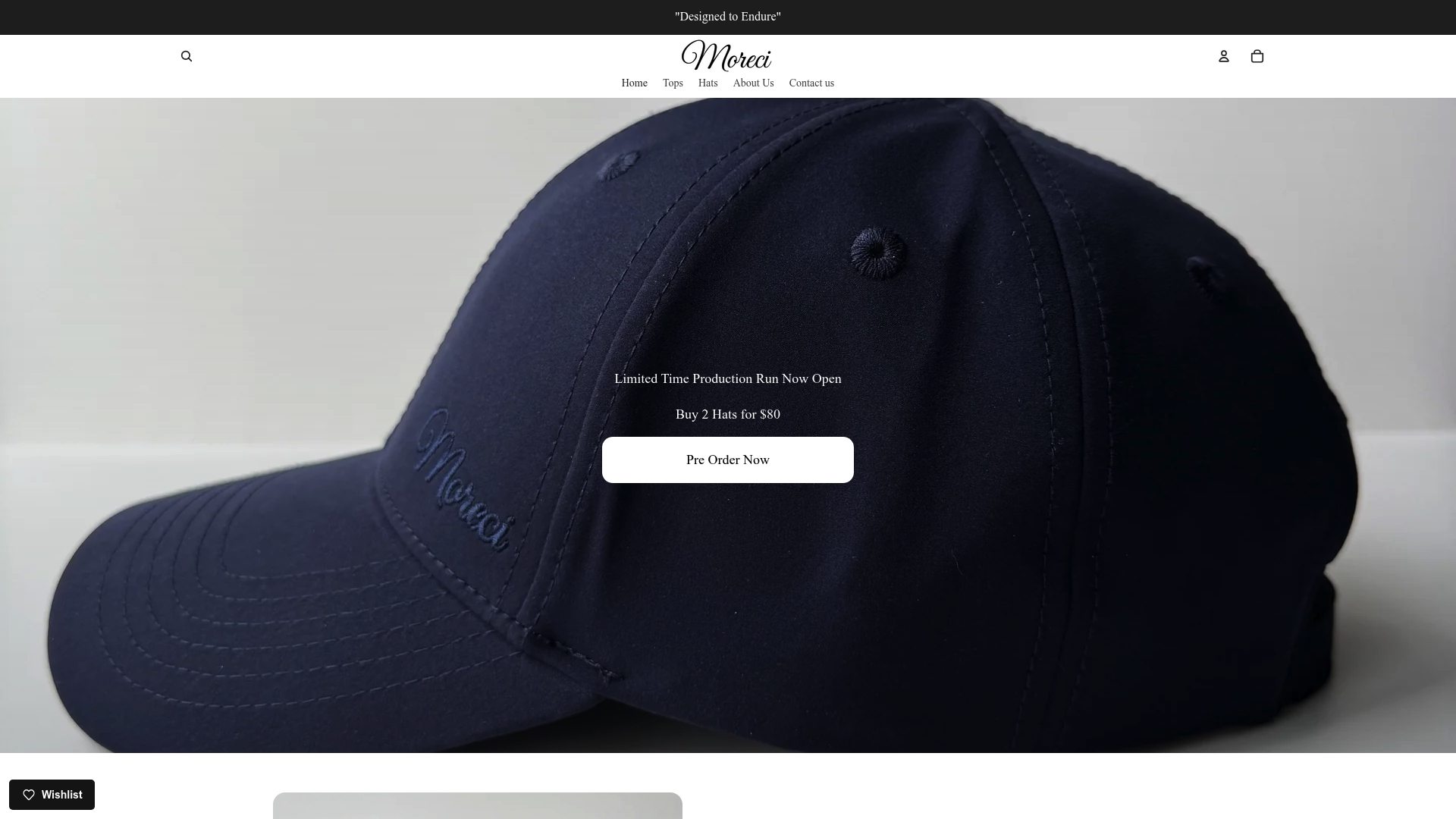
The Cappellino baseball hat is a minimal, well-fitted cap that works as a running hat for casual runs and doubles as everyday wear. No logos, tailored fit, quality materials. For men who want gear that does not look like gear when they are done running, that matters.
Browse the Moreciandco store to see the full range. Every piece ships with a clear return policy, so fit is never a gamble.
Sources
- Essential Running Gear | REI Expert Advice
- Essential Running Gear for Beginners You Can Buy in One Trip
- Running Gear Essentials: The Kit Every Runner Needs - The Running Channel
- Running Gear Checklist | AI Fit Hub
- Best running accessories: 10 running must-haves
- Physical Activity Guidelines 2nd edition
- Frontiers in Sports and Active Living article