


A properly fitting baseball cap sits snug but never tight, with the brim resting just above your eyebrows and no pinch at the temples. The fastest gut check is the two-finger rule: slide two fingers between the sweatband and your forehead. If they slip in with slight resistance, you’re set. Circumference gets you close, but crown depth decides whether the cap actually sits right.
TL;DR:
- Measuring head circumference accurately and considering crown depth are essential to finding a cap that truly fits and feels comfortable over time.
- Caps with a shallow or deep crown can look vastly different despite having the same circumference, affecting overall appearance and fit.
- For variable hairstyles or frequent hair changes, adjustable caps or stretch hybrids provide better flexibility and comfort.
- When between two sizes, always choose the larger to prevent tightness, and use hat reducers for slight loosening if needed.
- Emphasizing fit over style or trend ensures a cap that remains comfortable and supportive during everyday activities and high-movement sports.
Table of Contents
- What Does a Correctly Fitting Baseball Cap Feel Like?
- How Do You Measure Your Head for the Right Cap Size?
- Why Crown Depth Changes How a Cap Fits
- Adjustable, Fitted, or Flexfit: Which Construction Fits You?
- What Should You Do If You’re Between Sizes?
- Common Baseball Cap Fitting Mistakes to Avoid
- How to Break In and Care for a New Baseball Cap
- How Do Hair Thickness and Hairstyle Change Cap Fit?
- How Does the Activity You Wear a Cap For Change the Fit You Want?
- How Do Fit Standards Differ Across Cap Brands and Styles?
- Why Fit Should Beat Trend Every Time You Buy a Cap
- Where to Find a Cap Built Around Fit, Not Just Looks
- Sources
What Does a Correctly Fitting Baseball Cap Feel Like?
Baseball cap fit comes down to a handful of physical checkpoints you can run through in under a minute, ideally in front of a mirror. The brim should land just above your eyebrows, not resting on them and not pushed back toward your hairline. Your ears shouldn’t feel squeezed by the band running along the sides.
Tilt your head side to side and give it a light shake. A cap that fits should stay put without shifting, and it shouldn’t lift in a light breeze either. If you’re constantly adjusting it or catching it before it slides off, the size is wrong, not your habits.
Comfort has to hold up over time, not just in the first thirty seconds:
- No red marks or indentation lines on your forehead after an hour of wear
- No throbbing or tension headache building at the temples
- No looseness that lets the cap rock forward when you look down
- Even pressure across the whole band, not concentrated at one point
The two-finger rule is the quickest way to confirm all of this at once. Two fingers with light resistance means the band is doing its job: enough grip to stay secure, not enough to leave a mark.
How Do You Measure Your Head for the Right Cap Size?
Skip the guesswork and grab a flexible tape measure or a strip of string and a ruler. This is the same method reputable sizing guides recommend, and it takes about two minutes.
- Wrap the tape roughly 1 centimeter above your eyebrows, keeping it level across your forehead.
- Continue the tape over the tops of your ears and around the widest part of the back of your skull.
- Pull the tape snug, the way you’d tighten a firm handshake, not stretched taut.
- Note the number, then measure a second time to confirm.
- Measure with whatever hairstyle you normally wear under a cap, since a bun or thick hair changes the result.
Pro Tip: If your two measurements land between sizes, always record the larger number. Baseball cap sizing forgives a hat that’s slightly loose far more than one that’s tight.
Fitted caps typically convert circumference into fractional sizes like 7 or 7⅜, while most everyday caps stick to simple S/M/L bands that cover a few centimeters of range each. A quarter inch of slack in your measurement rarely matters on an adjustable cap, but it matters a lot on a fitted one.
Why Crown Depth Changes How a Cap Fits
Circumference tells you how wide the cap is. Crown depth tells you how deep the cap sits down over your skull, and it’s the variable most shoppers never check. A standard crown runs around 9 to 10 centimeters; anything past 10.5 centimeters counts as a high-profile or deep crown, while anything shallower is a low-profile build.
This is why two caps with an identical circumference number can feel completely different on your head. A shallow crown on a rounder head can sit like a bowl, riding high and looking oversized, while a deep crown on a smaller head can swallow your forehead.
When you’re shopping, especially buying baseball caps online where you can’t try before you buy, look for:
- Crown height listed in the product specs, not just circumference
- Product photos showing the cap on a model, which hint at how the crown sits
- Language like “low-profile,” “structured,” or “high-crown” in the description
- Customer photos or reviews mentioning whether the cap runs deep or shallow
Adjustable, Fitted, or Flexfit: Which Construction Fits You?
The band mechanism matters as much as the measurement itself. Each construction solves a different problem.
- Adjustable (snapback, strapback, or slide buckle): Built for a wide range of head sizes and hairstyles that change day to day. Best for anyone who isn’t fully sure of their exact size, or who wears their hair differently from one day to the next.
- Fitted: No back adjustment at all, which gives a cleaner, more finished silhouette. This only works if your circumference measurement is accurate, since there’s no fallback if you guess wrong.
- Flexfit or elastic-band hybrids: A stretch band absorbs small variances, splitting the difference between the structure of a fitted cap and the forgiveness of an adjustable one.
As a rule of thumb: if your hairstyle changes often or you’re not confident in your measurement, go adjustable. If you want that seamless fitted look and you’ve measured twice, go fitted.
What Should You Do If You’re Between Sizes?
When your measurement lands right on the border between two sizes, don’t split the difference by guessing. Go with the larger size every time.
- Order or select the bigger of the two sizes.
- If it feels slightly loose, apply hat-reducer foam tape inside the sweatband to tighten the fit by fractions of a size.
- Test it after the reducer is in place; add a second strip only if it’s still loose.
- If the cap still gaps at the temples, request an exchange rather than living with it.
Pro Tip: Hat reducers are invisible once installed, and they’re the standard fix retailers use for a fitted cap that runs a touch big. There’s no equivalent fix in the other direction. A too-small cap has no safe way to expand without stretching the fabric out of shape, so don’t buy small hoping it’ll loosen up.
Common Baseball Cap Fitting Mistakes to Avoid
A lot of fit complaints trace back to the same handful of habits.
- Cranking the snapback or strap to its most extreme notch to compensate for the wrong base size. Relying on the adjuster as a permanent fix usually means you bought the wrong size and it often distorts the crown over time.
- Measuring with the tape pulled too tight, or measuring bare headed when you normally wear the cap over thick hair or a ponytail.
- Wearing the brim too low over the eyes or pushed too far back, both of which throw off the visual proportion the cap was designed for.
- Trying to force a brand-new, stiff cap into shape by aggressively bending or crushing the brim on day one.
Small corrections here solve most fit complaints without buying a second hat.
How to Break In and Care for a New Baseball Cap
A brand-new cap almost always feels stiffer than it will after a few wears, and that’s normal. Wear it around the house in short stretches, thirty minutes to an hour at a time, so the materials warm up and mold to your head naturally.
- Wear in short home sessions rather than one long outdoor stretch on day one.
- Spot treat sweat stains with a damp cloth and mild soap instead of tossing the cap in a washing machine.
- Hand wash the sweatband area specifically if odor builds up, then air dry away from direct heat.
- Reshape the crown while it’s still slightly damp, pressing gently from the inside rather than bending the brim from the outside.
Pro Tip: Never dry a cap on a heater vent or in direct sun. Fast heat shrinks the fabric unevenly and can permanently warp the brim curve you worked to break in.
How Do Hair Thickness and Hairstyle Change Cap Fit?
Your hair is functionally part of your head size, and ignoring that is one of the most common reasons a cap that measured fine feels wrong on wear day. If you measured bare headed but usually wear your hair loose and thick, your actual fit under the cap runs tighter than the number suggests. The reverse causes problems too: measuring over a bulky bun or braids, then wearing the cap with hair down, leaves you with a cap that gaps and slides.
Curly and coarse hair textures tend to add more consistent volume than fine, straight hair, which is part of why adjustable constructions are so popular. A strapback or snapback gives you a few centimeters of daily flex for hair that puffs up in humidity or flattens after a workout. Buzz cuts and very short styles sit at the other extreme. With almost no hair volume to account for, the true skull measurement is what you’re fitting to, which makes fitted caps a realistic option since there’s no daily variable to plan around.
Ponytails and buns deserve their own note. A high pony pushes against the back panel of most caps and can force the brim up in front, changing the eyebrow line the cap sits at. If that’s your everyday style, look for caps with an adjustable strap positioned low on the back, or consider a slightly deeper crown that has room to accommodate the extra bulk without tipping forward.
How Does the Activity You Wear a Cap For Change the Fit You Want?
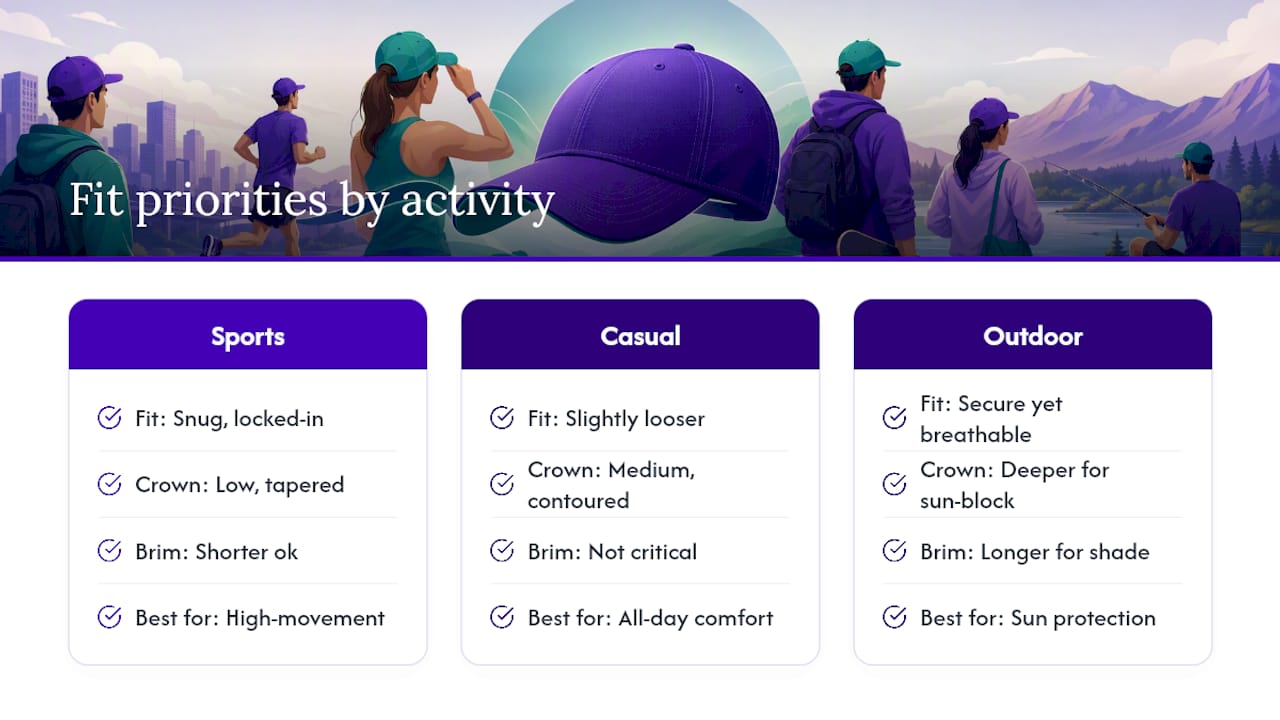
Fit priorities shift depending on what you’re actually doing while wearing the cap, and treating every hat as interchangeable is where a lot of buyers go wrong. Sports and high-movement activities call for a snug, locked-in fit with almost no wiggle room, since a cap that shifts during a sprint or a swing is a distraction at best and a hazard at worst. This is where a tapered athletic profile earns its reputation. A lower, more contoured crown reduces wind drag and stays anchored even with sweat working against the band.
Casual, everyday wear allows more flexibility. A slightly looser fit that’s comfortable for eight hours of running errands or sitting at a desk matters more than a locked-down, athletic seal. Comfort over a full day beats maximum security for a two-hour game.
Outdoor and sun-focused wear adds another wrinkle: brim shape and depth matter as much as circumference, since a deeper crown with a longer brim blocks more sun but can feel bulkier for casual use. Someone buying one cap to cover both a weekend hike and a workday commute is better served by an adjustable, medium-profile design than by either extreme.
How Do Fit Standards Differ Across Cap Brands and Styles?
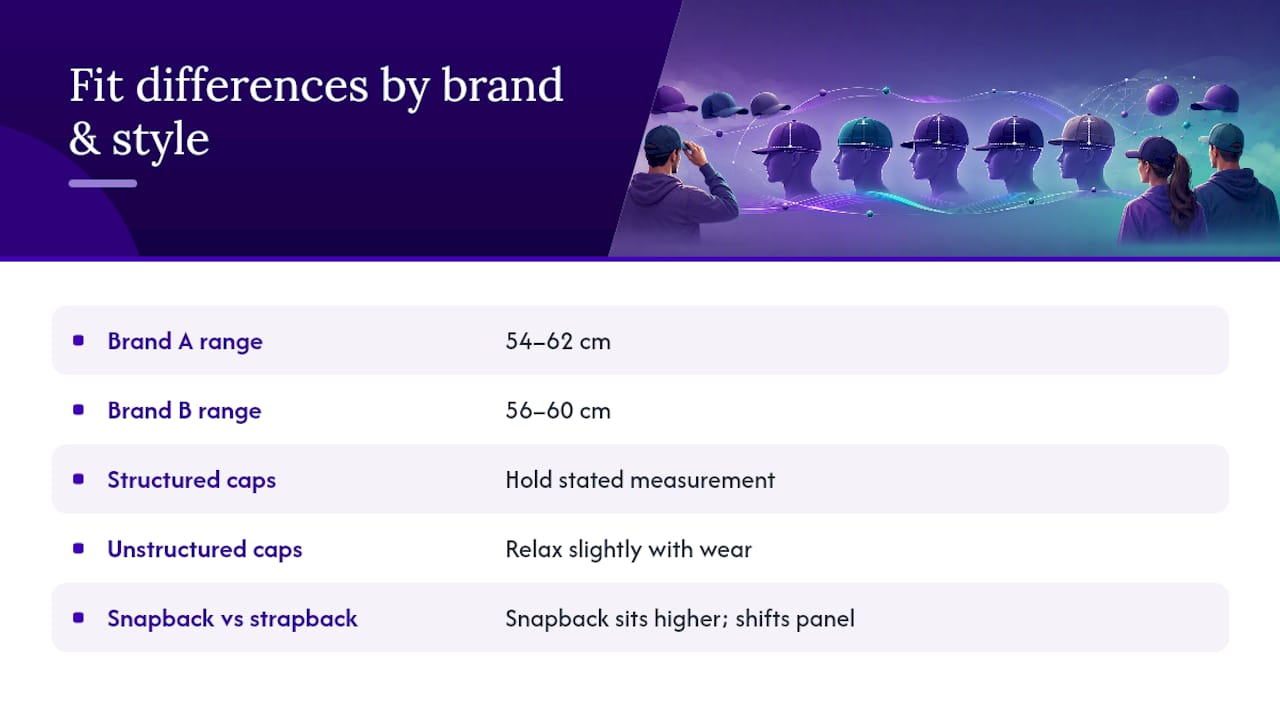
There’s no single industry standard for what “medium” or “one size fits most” actually means in centimeters, which is the single biggest source of frustration when buying baseball caps online. One brand’s adjustable “one size” might comfortably span 54 to 62 centimeters. Another’s might realistically only cover 56 to 60, even though both use identical marketing language on the product page.
Structured caps, the kind with buckram lining that holds a stiff dome shape, generally run truer to the stated measurement since the interior doesn’t compress much. Unstructured or “dad hat” styles are softer and tend to relax slightly with wear, so a snug fit out of the box often loosens into a comfortable one within a few weeks. Factor that into your decision if you’re between sizes on an unstructured style.
Snapback closures typically sit higher on the back of the head than strapback closures, which changes how the crown depth translates to actual coverage, as seen in the Gulf of America Baseball Cap’s adjustable snapback construction. A high-profile snapback and a high-profile strapback with the same stated crown height won’t always look or feel identical once worn, because the strap position shifts where the panel sits. This is also where checking a size chart specific to the exact cap style, not just a brand’s general size chart, pays off. Skimming one generic size guide across a brand’s entire catalog is a common source of returns.
Why Fit Should Beat Trend Every Time You Buy a Cap
Most people shop for a cap based on color or logo placement first and fit second, and that’s backward. A cap that photographs well but pinches your temples after an hour isn’t a good purchase regardless of how it looks in the mirror for the first thirty seconds.
The company emphasizes unbranded, tailored caps prioritizing fit and material quality over decoration. The measuring and break in guidance throughout this piece isn’t theoretical. It’s the same process worth running before buying any cap, from any source, because a hat you actually reach for every day is one you measured for rather than one you liked in a thumbnail.
Measure twice, check the crown depth, and only then start comparing styles. That order matters more than most shoppers realize.
— Giuseppe
Where to Find a Cap Built Around Fit, Not Just Looks
The baseball caps are designed with measurement and crown-depth principles in mind, focusing on tailored fit and durable materials rather than flashy branding. If you’ve already measured your head circumference and know your ideal crown depth, that’s the entire decision made for you before you even open a product page.
Start with the Cappellino baseball hat, a versatile style built for everyday wear once you’ve confirmed your size using the steps above. If you’re building out a wardrobe beyond headwear, the Complesso collection covers the same fit-first, quality-first approach in shirts and outerwear. And if your measurement lands right between two sizes, order the larger option first. The returns process aims to facilitate exchanges for a better fit, making it easier to find a suitable cap.
Sources
- How to Wear a Baseball Cap the Right Way - Hewore
- How A Baseball Cap Should Fit: The Ultimate Fit Guide - ProWearTrends
- How Should a Baseball Hat Fit? A Complete Guide - NotchGear